787 vs A350: The Whole New-Widebody Market Until 2030
Boeing's 777-9 just slipped to 2027 again. With the bridge airframe out of the picture for the rest of the decade, every major full-service carrier's premium-cabin strategy is committed to the 787 or A350 bet it placed years ago.
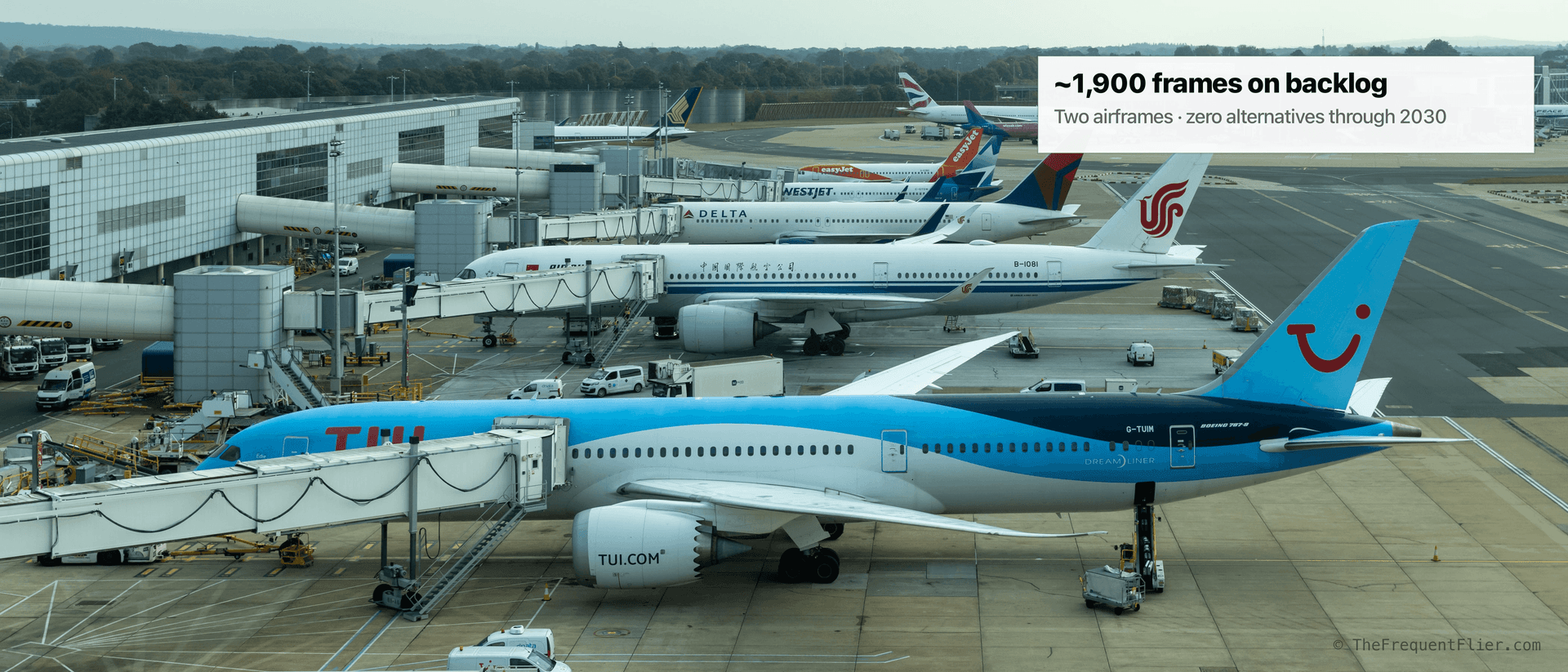
Boeing's 777-9 will not deliver before 2027. Around 30 already-built airframes need pre-delivery rework first. On the Q1 2026 earnings call in late April, Boeing CEO Kelly Ortberg said the work will take "years." Lufthansa, the launch customer, is publicly preparing fleet contingencies.
The news is the 777X. The post is about the airlines downstream of it.
The 777X is out of the new-widebody market through 2030. Every full-service carrier with long-haul ambitions chose 787 or A350 between roughly 2010 and 2020. That bet is the platform they're flying for the rest of the decade.
A two-platform market by elimination
There is no third option.
- 777X: 2027 at earliest, ramping slowly.
- A330neo: ~191 delivered in seven years; a smaller-widebody hedge Delta is using, most carriers aren't ordering at scale.
- A380: production ended December 2021.
- 767 passenger: last frame delivered to Air Astana in 2014.
- 747: out.
What's left to order new in 2026 with delivery before the end of the decade: 787 or A350. That's the whole supply curve.
Boeing has the head start. Roughly 1,230 787s have been delivered. Another 1,059 are on order. Airbus is younger and ramping. About 714 A350s have been delivered through April 2026. The order book carries 1,579 firm orders from 66 customers, with Turkish Airlines leading the queue at 110 frames.
On production rates: Airbus is targeting 12 A350s a month by 2028. Boeing is aiming for 8 787s a month.
Who committed to what
The widebody choices major carriers made years ago are now visible commitments.
American Airlines went pure 787 in April 2018. AA terminated a 22-frame A350 order. It ordered 47 more 787s the same day. The 767-300s, A330-300s, and 777-200ERs went into retirement. The all-Boeing widebody architecture has been locked in for eight years. Project Olympus, the 777-300ER retrofit covered in the premium-retrofit-math post earlier this week, fills the capacity gap an A350 would have served.
United Airlines has had A350s on order since 2009 — restructured to 45 A350-900s in 2017 — and has been deferring deliveries ever since. In February 2026, UA removed the Airbus widebody from its 10-K expected deliveries after a Rolls-Royce dispute over a $175M commitment payment. The order remains on the books, but with no delivery expected before 2030, the practical platform is the 787. UA recently ordered 50 more of them.
Delta is the cleanest counter-case. No 787s, no orders. Delta flies A350-900s, and the aging 767s and A330ceos are being retired. On January 28, 2026, Delta added 31 more widebodies from Airbus: 16 A330-900s and 15 A350-900s. After deliveries, Delta projects 55 A330neos and 79 A350s. The platform commitment is total.
Air France-KLM Group is the other major Airbus-widebody story. The Group placed a 50-aircraft A350 firm order with 40 options. KLM takes its first A350-900 in late summer 2026. The new A350s replace KLM's 777-200ERs, A330-200s, and A330-300s. After delivery completion, AF-KLM is on track to be the largest A350 operator in the world.
Lufthansa runs the canonical hedge. Its new Allegris premium cabin product is on 10 Munich-based A350s and 9 Frankfurt-based 787s. Same brand on both. The certification work is platform-specific.
| Carrier | 787 fleet | A350 fleet | New widebody orders | Commitment |
|---|---|---|---|---|
| AA | 787 fleet70 (37 × 787-8, 33 × 787-9) | A350 fleet0 (terminated 2018) | New widebody ordersProject Olympus retrofit on 777-300ER | CommitmentAll-787 (decision) |
| UA | 787 fleet70 in fleet, 50 on order | A350 fleet45 deferred past 2030 | New widebody orders50 more 787s on order | CommitmentAll-787 (attrition) |
| DL | 787 fleet0 | A350 fleet40 in fleet, 15 on order | New widebody orders16 × A330-900, 15 × A350-900 (Jan 2026) | CommitmentAll-Airbus widebody |
| AF | 787 fleet0 | A350 fleet41 in fleet, 50 on order | New widebody orders50 × A350, plus 40 options (Group) | CommitmentTransitioning to A350 |
| LH | 787 fleet9 with Allegris | A350 fleet10 with Allegris | New widebody ordersA350-900, A350-1000, 787-9, 777-9 | CommitmentDual-platform hedge |
| QR | 787 fleet~58 | A350 fleet62 (34 × A350-900, 28 × A350-1000) | New widebody ordersBoth ongoing | CommitmentBoth, A350-1000 dominant |
What commitment actually costs
Three concrete costs make this a commitment, not a rhetorical flourish.
Pilot type ratings. A 787 type rating does not fly an A350 and vice versa. Cross-platform conversion is a multi-week training program, simulator time, and a line check, per pilot. A carrier running both fleets either maintains two pilot pools or pays for dual-qualification across thousands of pilots.
MRO ecosystem. The 787 fleet runs on GE GEnx or Rolls-Royce Trent 1000 engines — two pools of spares, shop visits, and supplier contracts. The A350 runs on Rolls-Royce Trent XWB only. Adding a second platform means standing up a parallel maintenance infrastructure.
Premium-cabin certification. Each business class suite is certified to the airframe variant it's installed on. Lufthansa Allegris is the cleanest illustration. Within a single airline group, with a defined product brand and €2.5B program budget, Lufthansa could not certify Allegris on the A380 in time for the retrofit window. The A380s are getting a Thompson Aero Vantage XL product instead. Three different business class cabins now fly under the same livery.
The 777X was supposed to be the universal third option. A high-capacity, high-range airframe most full-service carriers could add to whichever platform they already had. With the 777X out, switching platforms mid-decade is structurally too expensive. The bridge airframe doesn't exist.
Which bets age best
The A350 ages best for ultra-long-haul. Singapore Airlines flies SIN-JFK and SIN-EWR on the A350-900ULR. SQ24 is the longest scheduled commercial flight in service. Qatar Airways operates the largest A350-1000 fleet, and the -1000 anchors its Doha-to-everywhere position. Cathay Pacific runs HKG-JFK and HKG-EWR with A350s. Qantas's Project Sunrise launches in 2027. The 12 A350-1000ULRs Qantas ordered will add SYD-LHR and SYD-JFK to the list. The ULR variants do range work no current 787 can do without compromising payload.
The 787 ages best for network flexibility. ANA flies 88 of them — the largest 787 fleet in the world. The planes work short-, medium-, and long-haul Asian and trans-Pacific missions. The 787-9 is the most versatile new widebody in service. It does the job on medium-density routes where an A350-900 would be oversized, and on long-haul where the A380 used to fly. AA, JAL, and BA all run 787-heavy long-haul networks because the airframe fits a wide mission profile.
Dual-platform carriers get optionality value. Lufthansa Group, Japan Airlines, and Air France-KLM all run both. They pay the parallel-MRO cost and the type-rating overhead in exchange for using each airframe where it does its best work. Whether the optionality pays back depends on whether the network actually spans both mission profiles.
The bets in trouble are rarer than the supply-curve frame suggests. United is the clearest case. UA's A350-900s were the carrier's plan for ultra-long-haul missions the 787 doesn't reach. After the Rolls-Royce dispute deferred those deliveries past 2030, UA is an all-787 carrier by attrition rather than choice. The 787-9 and 787-10 are excellent airframes. They're just not the ones UA's fleet planners picked. Outside UA, most major carriers committed deliberately to platforms that fit their networks. The bigger commitment problem isn't the wrong choice — it's that the choice is now permanent for the rest of the decade.
The 787 and A350 bets were supposed to be transitional. They're the whole decade.
The 777X delay answered a question the industry never asked out loud: who actually needed it, and who already had a working answer? Most full-service carriers had picked their widebody platform years before the program slipped definitively. The order book Boeing built for the 777X was always thinner than the pitch suggested. Now it's been off the table for the entire pre-2030 cycle. The 787 and A350 bets that were supposed to be transitional are the era.
Explore the data
Agree or disagree?
Tell me what I missed, what you'd add, or where the argument breaks.