Every Day Robert Isom Stays Is a Question About AA's Board
The stock has stopped responding. The peers are 31–45× more profitable. Both unions have publicly lost confidence. A competitor publicly pitched buying the company. The board has had every reason to act and hasn't.
I've been loyal to American my whole adult life — often to a fault. I've lived in Hawaii, San Francisco, and Boston: three cities where staying with AA has gotten progressively harder. AA went from being Logan's largest carrier to its fifth. SFO is United's hub, full stop. Honolulu is mostly served from DFW and LAX. I've stayed anyway.
So when I say it's time for Robert Isom to go, this isn't the conclusion of someone shopping for grievances. It's the conclusion of someone who's been hoping to be wrong for years.
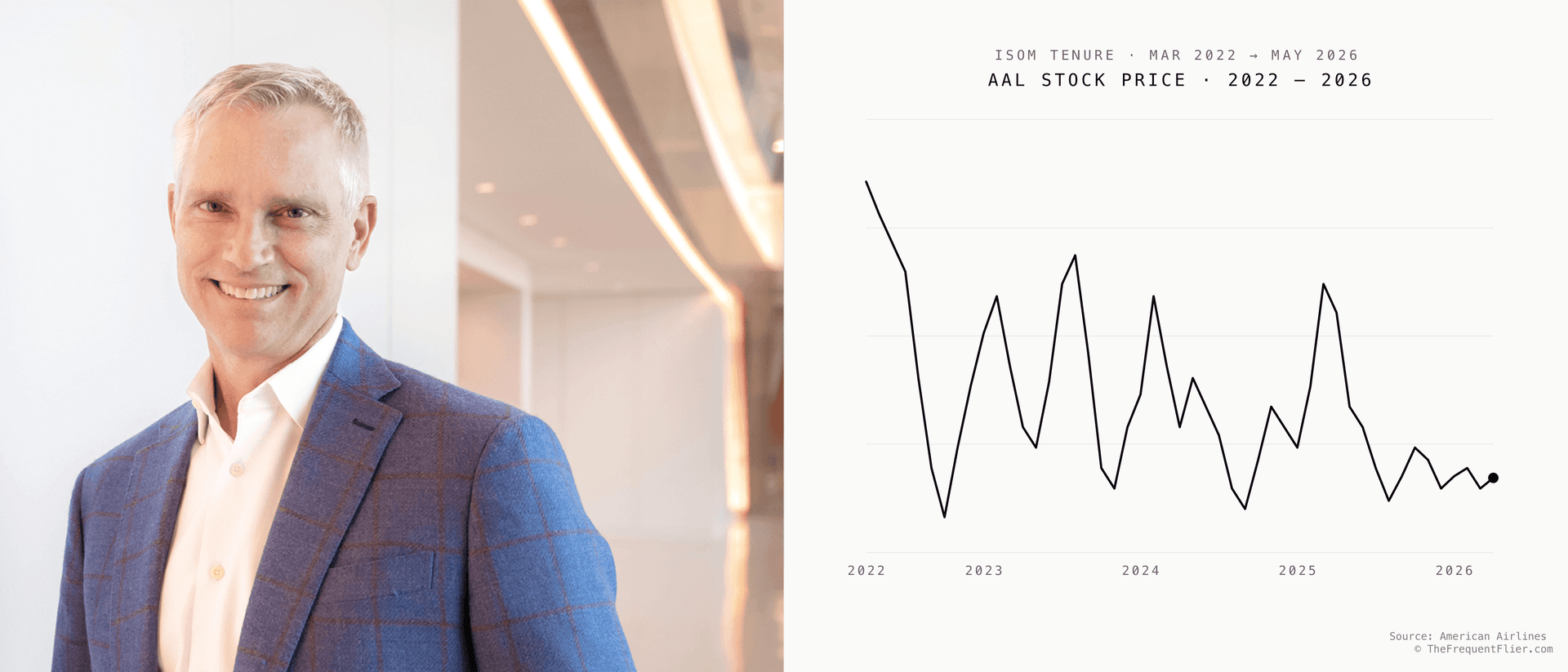
He's been CEO since March 31, 2022. Four years and one month. In that window, three things have become impossible to argue with.
Wall Street has stopped pretending.
Since Isom took over, AAL has gone roughly nowhere. United and Delta have both moved meaningfully in the other direction. There are honest reasons a single stock might lag for a quarter or two. There aren't honest reasons for four years of underperformance against directly comparable carriers, running directly comparable hubs, in directly comparable macro conditions.
At some point the pattern stops being about the macro and starts being about the operator.
The gap with peers is no longer a gap. It's a chasm.
Delta made roughly 45 times what American made on revenue that was within 16%. United made roughly 31 times on revenue within 9%.
The 2025 number isn't an outlier. Walk the comparison back to Isom's start date and the gap has been persistent and widening. American is the largest U.S. airline by some measures and the worst-managed by every financial one.
The unions have stopped trying to be diplomatic.
On February 6, 2026, the Allied Pilots Association — representing 16,000 AA pilots — wrote to the board and demanded a direct meeting. The board refused and sent Isom himself instead. The pilots told the public they had "lost confidence in management's ability to correct course."
Three days later, on February 9, the Association of Professional Flight Attendants — 28,000 cabin crew — voted unanimously no-confidence in Isom. First in the union's history. APFA president Julie Hedrick called the period under Isom a "relentless downward spiral."
Two weeks before all of this, Winter Storm Fern produced over 9,000 AA cancellations — the largest weather-driven disruption in the airline's history. CFO Devon May confirmed the cost: $150–200 million in revenue, 1.5 percentage points of Q1 capacity gone.
On March 29, the pilots escalated again. On April 27, United CEO Scott Kirby publicly confirmed he'd pitched the Trump administration on a UA/AA merger — antitrust would never permit it, but the symbolism was the point. Boyd Group's Michael Boyd put it cleanest, on Fox Business: "This is a proud airline… but it's an airline now that's been, quite frankly, non-managed."
What is the board actually for?
This is the question I keep coming back to.
Public-company boards exist for one job: hold management accountable when the evidence is overwhelming. The evidence here is overwhelming. Wall Street has spent four years pricing Isom's tenure. Both major unions have publicly lost confidence in management. The CFO has acknowledged the operational damage in the hundreds of millions. A direct competitor publicly pitched buying the company. Outside analysts are naming the problem on cable.
Every day Isom remains at the helm, the meaningful question isn't "when will the board replace him."
It's: what would this board ever replace anyone for?
Explore the data
Agree or disagree?
Tell me what I missed, what you'd add, or where the argument breaks.