The Alaska / Hawaiian Merger Is Done. Except for the Pilots.
April 22 was the last major customer-facing step on the announced integration roadmap. From a passenger's chair, Alaska and Hawaiian function as one airline now. From a labor-contract chair, the merger has another chapter to go.
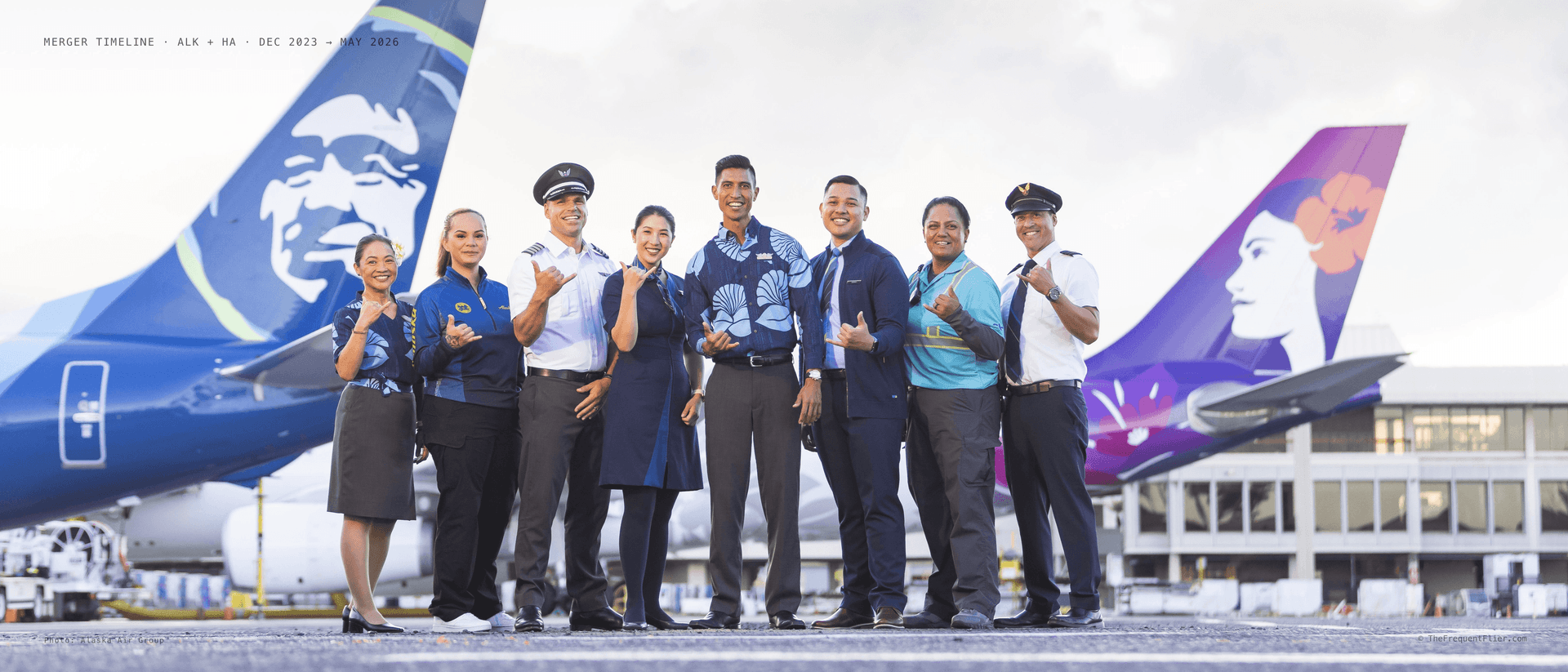
On April 22, three things happened in one day.
Hawaiian's reservation system migrated from Amadeus to Alaska's Sabre. Every Hawaiian flight number flipped from "HA" to "AS." And Hawaiian Airlines formally joined oneworld. If you booked a Hawaiian flight on April 21, you'd been buying it on hawaiianairlines.com from a different reservation backend than Alaska. By April 23, it was the same backend, the same flight prefix, the same alliance. For a passenger, the merger is — give or take some loyalty edge cases — finished.
That's worth pausing on, because by airline-merger standards, it's also fast.
The deal was announced on December 3, 2023. The DOT cleared it (with binding public-interest commitments) on September 17, 2024. The acquisition closed the next day. The Single Operating Certificate (SOC) — the FAA document that says "we recognize you as one airline" — followed on October 29, 2025. Atmos Rewards launched on September 2, 2025; HawaiianMiles members migrated October 1. April 22 was the last major customer-facing step on the announced roadmap.
Just under 29 months from announcement to the customer-facing "we're one airline" moment. United / Continental took 22 months on the same yardstick. American / US Airways took 32. Alaska / Hawaiian is sitting in the middle — and so far, two weeks in, with a passenger service system (PSS) cutover that has run cleaner than either predecessor's did. Worth re-checking that claim in 30 and 60 days; cutover problems often surface as irregular operations (IROPs) and revenue-management edge cases over weeks, not days.
Months from announcement to customer-facing 'one airline' moment
months
So is the merger done?
For everything you can see from a window seat: yes.
For everything that isn't a passenger-facing system: not yet. Two things are still open, and one is a long-running compliance regime.
The pilot joint collective bargaining agreement (JCBA). Negotiations between Alaska's and Hawaiian's pilot leadership — both groups represented by the Air Line Pilots Association (ALPA), each through its own Master Executive Council (MEC) — and Alaska management opened on February 26, 2025. Fourteen months in, no tentative agreement has been announced. Until that contract ratifies, ~3,300 Alaska pilots and ~1,200 Hawaiian pilots are flying under separate agreements and can't be staffed across the combined system. After ratification, the two MECs' merger committees still have to combine the seniority lists before pilots can bid trips on the other airline's metal. The JCBA has now been active longer than the FAA's SOC review took.
The flight attendant JCBA. The Association of Flight Attendants (AFA) Joint Negotiating Committee met April 28–30 in Seattle and is scheduled to reconvene June 2–4. Same gating function as the pilots: pre-merger groups can't be combined operationally until the joint contract ratifies, the FAA signs off on combined safety procedures, and the seniority lists merge.
The DOT public-interest commitments. These aren't milestones to "complete" — they're an ongoing compliance regime. The route-maintenance commitment, specifically, runs for six years from approval, through approximately September 17, 2030: the combined carrier is contractually obligated to maintain inter-island and key mainland-Hawaii routes that Hawaiian flew before the deal. Other commitments — rewards-value preservation, non-discriminatory access at Honolulu (HNL), fee-free family seating — are framed as binding obligations on the combined carrier and run on their own clocks.
Why this matters for what comes next
The thing that historically blows up airline mergers isn't reservation technology. It's pilot seniority.
The pilot-seniority dispute from the 2005 America West / US Airways merger ran through arbitration and federal court for years, only being effectively resolved when it was folded into the AA / US Airways pilot JCBA a decade later. Pilots who'd been hired on different days at different airlines ended up flying for the same carrier under fundamentally different bidding economics — and litigated the difference at length.
Alaska / Hawaiian is starting at a much smaller scale: under 5,000 pilots combined versus roughly three times that at AA / US Airways. The pilot groups have been negotiating jointly through ALPA, not across competing unions. The probability of a clean integration is higher than the historical comp suggests. But "higher than AA/US Airways" is a low bar.
The next real milestone to watch isn't a customer-facing one. It's a tentative agreement announcement from the joint pilot negotiation. Until that happens, the merger has a finish line you can't see from a window seat.
My read
This is — to my mild surprise as a longtime AA loyalist watching from the outside — a competently run integration. Just under 29 months to customer-facing completion, no headline-grabbing PSS meltdown, a loyalty program rebuild that handled both member bases at 1:1 with no expiration and no transfer fees — the kind of restraint a Marriott or Hyatt would have struggled to show. Alaska's operational discipline shows up in the merger execution itself.
But "done" isn't where this is yet. The labor side is the long pole, and the DOT's six-year route-maintenance window is the leash. From now until 2030, the combined carrier is being graded on whether it maintains the inter-island and key mainland-Hawaii routes — and the reward values — it promised in exchange for getting cleared.
The merger has a finish line you can't see from a window seat.
Strong beliefs, loosely held. Where am I wrong on this?
Explore the data
Agree or disagree?
Tell me what I missed, what you'd add, or where the argument breaks.