The FAA Just Cut Its Controller Target. Three Rules Made the Old Number Impossible Anyway.
The 2026–2028 workforce plan trims the goal by about 2,000 controllers. The shortage is built into an entry-age cap, a forced retirement age, and a training pipeline that runs for years.
If you fly enough, you've sat on a plane held for "staffing." Sometimes that's weather in nicer language. Often it's real: the radar room that sequences planes into your destination is short a few bodies, so the FAA slows the arrival rate until the controllers on duty can handle it safely.
On May 15, the FAA put a new number on that problem. Its 2026–2028 workforce plan sets a target of 12,563 fully certified controllers, down from the 14,633 the agency said it needed two years ago, a cut of about 2,000.
The old number was never reachable. The FAA didn't lower the target because the job got easier. It lowered it because three rules cap the controller workforce, and no hiring budget moves any of them fast.
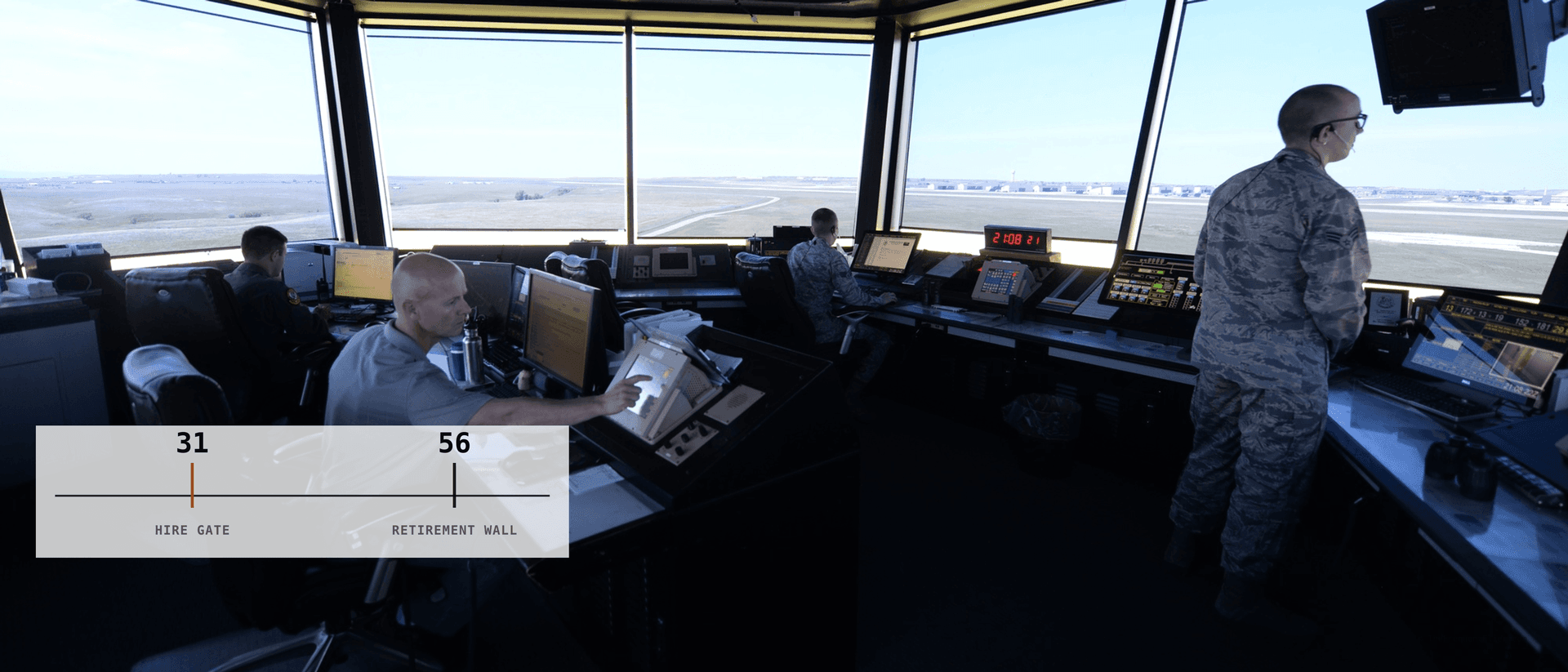
Rule one: you have to be hired before 31
The FAA won't bring on a new controller past their 31st birthday. There are narrow exceptions for people who already did the job in the military or at a contract tower, and veterans can get a waiver. For everyone else, miss the window and the career is closed before it starts.
This isn't quite a law. A federal statute lets the FAA set a maximum entry age; the agency picked 31. It picked 31 for a reason that only makes sense once you see rule two.
Rule two: you have to retire at 56
This one is law. Controllers are separated at 56, unless the Secretary of Transportation grants a rare extension to 61 for someone with exceptional skills. It dates to the 1970s, when the prevailing view held that the cumulative stress and shift work of the job made it unwise to keep people working traffic past their mid-50s.
Now the entry cap makes sense. The enhanced retirement controllers earn requires about 25 years of service. Count backward from 56 and you land at 31. The hiring cap exists to guarantee the FAA gets a full career out of anyone it trains. The two rules are bolted together.
Rule three: the training takes years, and many wash out
Get hired and the clock still doesn't start on a real position. New controllers spend three to four months at the FAA Academy in Oklahoma City, then move to their assigned facility to certify on the actual airspace. That second phase runs one to three years, longer at the busiest places. No college degree required to start. You do have to pass an aptitude screen and then survive the floor.
A lot of people don't. At the Oakland center, roughly 45% of trainees have failed to certify. At one of the New York facilities, some of the most complex airspace in the country, the washout rate has run near 69%. A hire is not a controller. A controller is someone who cleared a years-long filter that fails a large share of the people who enter it.
Stack the three together and the shape is clear: a narrow entry window, a forced exit at 56, and years of attrition-heavy training in between. To grow the workforce, the Academy has to certify new controllers faster than the system loses them at the top. The shortage isn't a budget the FAA forgot to spend. It's arithmetic.
The part that surprises people: the money is already there
The reflex fix is "pay more to attract people." But this is already one of the best-paid jobs in the federal government that doesn't require a degree. Senior controllers at the New York radar facility push base pay toward $185,000 before premiums, and a mid-career controller working six-day weeks with overtime can bump against the federal pay ceiling.
Controllers are unionized under NATCA, their union since 1987. But their pay tops out at a number Congress sets, not one a profitable employer competes to beat. That's the inverse of the airline labor market, where a carrier raises pay to win talent. You can't bid up a wage that's capped by law, and there's only one employer hiring. Pay isn't the bottleneck. The pipeline is.
What the target cut actually does
Two things, once you read it through the rules.
First, it closes the shortage on paper. The system runs roughly 11,000 certified controllers today. Against the old target of 14,633, that's a gap of about 3,600. Against the new 12,563, the gap is closer to 1,500. More than half the "shortage" disappears without a single new hire, because the agency restated the goal to something the pipeline might actually reach.
Certified controllers vs. the staffing target
- Certified today (~11,000)11,000 controllers75%
- Gap to the new target (~1,500)1,563 controllers11%
- Gap the old target added (~2,070)2,070 controllers14%
Second, it leans on productivity instead of headcount. The plan aims to raise the average time a controller spends actively working traffic from about four hours a shift to five, with automated scheduling to cut the reliance on overtime. That overtime isn't cheap: in 2024, controllers logged 2.2 million overtime hours at a cost near $200 million, with per-controller overtime up more than 300% since 2013. The FAA is buying output from the people it has because it can't buy enough new people in time.
The lever nobody pulls
If three rules build the cage, changing one of them is the only thing that opens it. Lift the entry age and you widen the funnel. Raise the retirement age and you keep experienced controllers in the chair longer, the move aviation already made for pilots, who now fly to 65 while controllers still leave at 56. Bills to nudge the retirement limit surface in Congress and then stall.
Three rules built this shortage. Changing one is the only thing that ends it.
The FAA just told us, in plain numbers, that it doesn't expect to hire its way back to the old target. The fix that would change the math is sitting in plain sight, and it's about rules, not money. Until one of the three changes, the next decade of staffing looks a lot like the last, and so does the ground stop you'll eventually sit through.
Agree or disagree?
Tell me what I missed, what you'd add, or where the argument breaks.