Six US Airlines Cut Summer Capacity. Frontier Added 3 Million Seats.
After Q1 earnings, the US airline industry split in half on capacity strategy. Same fuel curve, different math. The split tells you something the fuel narrative doesn't.
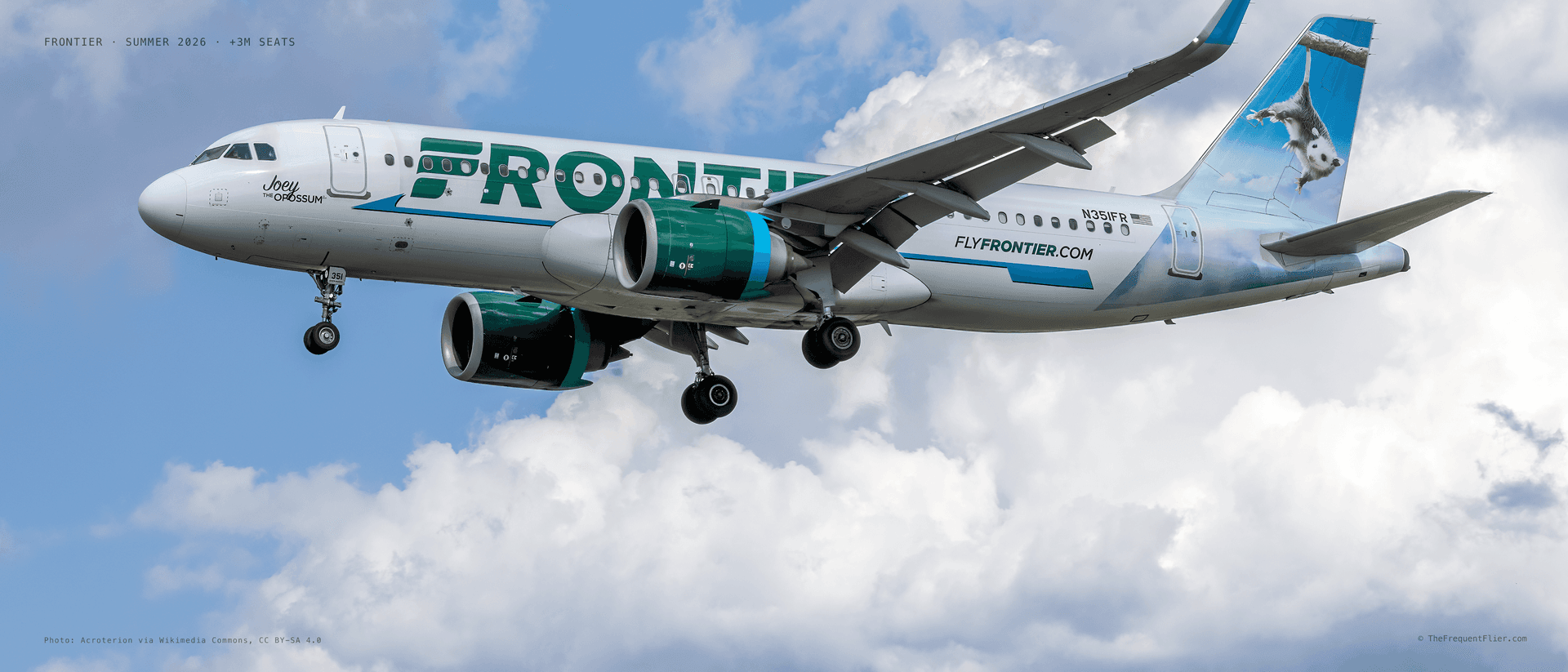
After Q1 earnings landed, the US airline industry split in half on capacity. Six carriers pulled back summer guidance. Frontier alone went the other way and added 3 million seats to its June–September schedule. Same fuel curve, same Q1 commentary, same investor expectations. Different decision.
Here are the numbers.
| Carrier | Carrier | Q1 2026 ASM YoY | Summer / full-year guidance |
|---|---|---|---|
 | CarrierFrontier | Q1 2026 ASM YoY−1% | Summer / full-year guidanceAdding 3M seats June–Sep; 18 former Spirit markets; 9 new routes + 15 daily departures |
 | CarrierUnited | Q1 2026 ASM YoY+3.4% | Summer / full-year guidanceCut 5 pts from plan; Q3/Q4 flat to +2% |
 | CarrierDelta | Q1 2026 ASM YoY−3% system / +1% domestic | Summer / full-year guidanceQ2 cut 3.5 pts; full-year roughly flat |
 | CarrierAmerican | Q1 2026 ASM YoY+3–4% | Summer / full-year guidanceTrimmed ~1 pt from plan |
 | CarrierSouthwest | Q1 2026 ASM YoY+1.5% | Summer / full-year guidanceTightened to +2% (low end of 2–3%); Q2 flat to +1% |
 | CarrierJetBlue | Q1 2026 ASM YoY−1.7% | Summer / full-year guidanceH2 −2–3 pts; full-year guidance suspended |
| Allegiant | CarrierAllegiant | Q1 2026 ASM YoY−5.9% | Summer / full-year guidanceQ2 −6.5% ("purely fuel-related") |






Frontier opened nine new routes, put 15 daily departures into 18 former Spirit markets — Orlando, Las Vegas, Dallas-Fort Worth, Detroit, Fort Lauderdale — and was already serving more than 100 former Spirit routes before the May 2 wind-down.
The fuel story is real. Jet fuel doubled in six weeks. United's earnings guide came down from $12–14 to $7–11; Delta said its Q2 fuel bill alone will be $2 billion higher year-over-year; Southwest is paying $4.10–$4.15 per gallon for Q2 versus $2.73 in Q1. Margins are getting compressed at every airline that flies a barrel of jet-A.
But fuel doesn't explain the asymmetry. Frontier faces the same fuel curve. Frontier's fleet at year-end 2025 was 164 A320-family aircraft, 85% of them neo-generation, generating 106 available seat-miles per gallon. The carrier looked at $150 fuel and a competitor's empty gates and chose to grow. Every other US airline looked at the same numbers and chose to shrink.
This is the US airline oligopoly in motion. The US3 — American, Delta, United — don't have to coordinate. They share the same financial models, the same fuel curves, the same investor expectations. When fuel doubles, the textbook response everywhere in the room is to discipline capacity. That's also the response that's already structurally rational for an oligopoly defending yield.
The fuel signal lines up with what the dominant players want to do anyway. From the outside, you can't separate a reasoned response from a structural one. Both produce the same fares.
Frontier breaks the pattern because Frontier sits at the wrong layer of the market for capacity discipline. The US3 and Southwest can ride yield. Frontier can't. It's a price-led carrier, and price-led carriers grow by eating into a competitor's footprint when one becomes available — and Spirit's footprint just opened up. The ULCC playbook depends on volume. Frontier had been positioning for this for months, with the largest neo-family fleet in the US sitting against a market full of grounded Spirit A320s the lessor base is currently pricing.
The stock market is reading it. The carrier behaving differently is the one being priced for the next leg, in a fuel regime that's punishing everyone else.
Two true things are happening at once. Fuel is forcing real decisions at real airlines. And the structure of the US airline industry rewards capacity discipline regardless of fuel. It gives the dominant carriers an honest-sounding reason to do exactly what they would have done anyway. Frontier proves both, by behaving differently and by being rewarded for it.
Explore the data
Agree or disagree?
Tell me what I missed, what you'd add, or where the argument breaks.