Philippine Airlines Joins oneworld. The Alliance Is Adding Coverage, Not Scale.
PAL signed on as oneworld’s 16th member at the IATA meeting in Rio. By revenue, fleet, and passengers it lands in the middle of the pack. What it actually brings is a Manila hub and the Southeast Asia gap the alliance had been flying around.
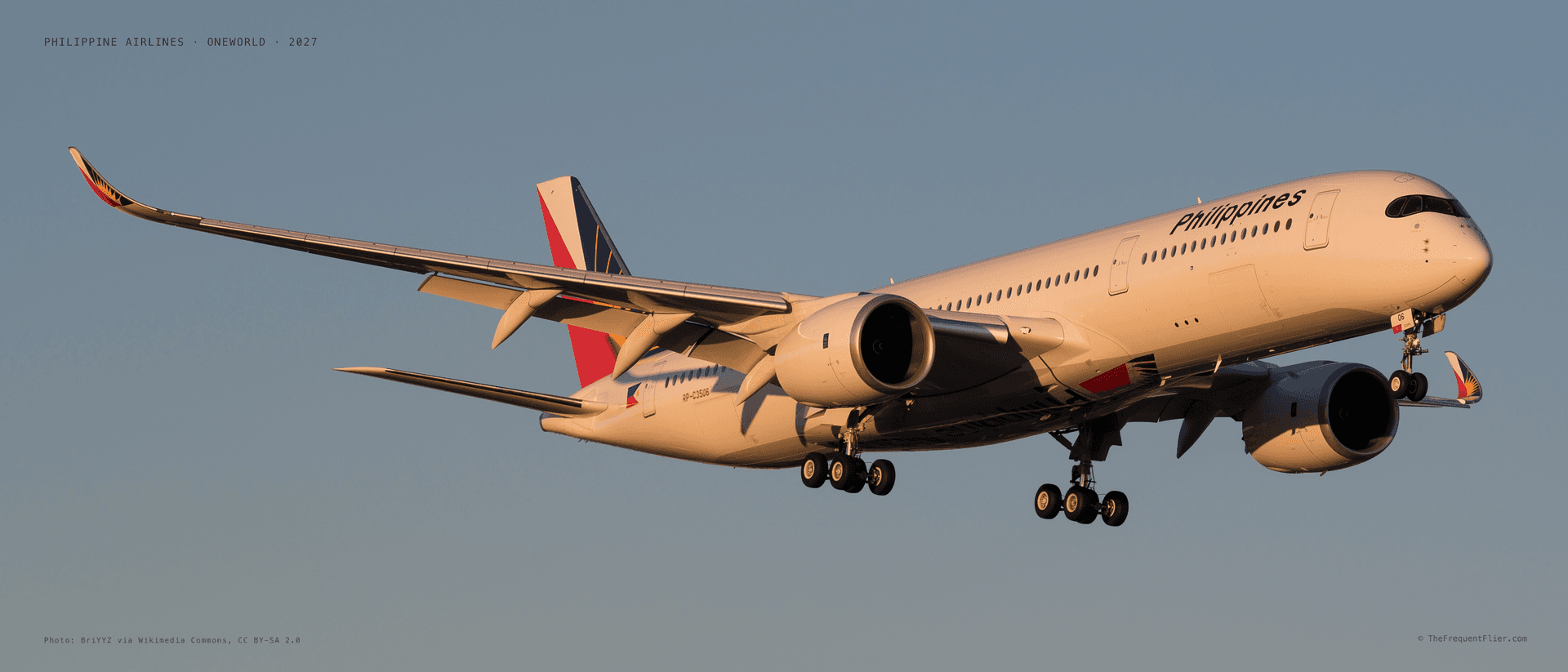
Philippine Airlines signed a memorandum of understanding on June 6 to become oneworld’s 16th member, announced at the IATA annual meeting in Rio de Janeiro. Full integration is expected in 2027 — the usual 12-to-18-month runway after a deal like this. PAL brings 31 destinations the alliance didn’t have, most of them Philippine island gateways like Boracay, Palawan, and Tawi-Tawi, plus a Manila hub that plugs a real hole in the map.
Start with where PAL sits among its new partners.
American Airlines
- #
- 1
- Hub
- Dallas/Fort Worth
- Joined
- 1999
- Fleet
- ~1,015
- Pax/yr
- ~224M
- Revenue
- $54.6B
Alaska Airlines
- #
- 2
- Hub
- Seattle
- Joined
- 2021
- Fleet
- ~328
- Pax/yr
- 58.6M
- Revenue
- $14.2B
Qantas
- #
- 3
- Hub
- Sydney
- Joined
- 1999
- Fleet
- 132
- Pax/yr
- 55.9M
- Revenue
- ~$15.6B
Japan Airlines
- #
- 4
- Hub
- Tokyo
- Joined
- 2007
- Fleet
- 146
- Pax/yr
- ~47M
- Revenue
- ~$12.1B
British Airways
- #
- 5
- Hub
- London
- Joined
- 1999
- Fleet
- ~254
- Pax/yr
- 46.3M
- Revenue
- ~$19.0B
Qatar Airways
- #
- 6
- Hub
- Doha
- Joined
- 2013
- Fleet
- ~230
- Pax/yr
- 43.1M
- Revenue
- ~$23.4B
Iberia
- #
- 7
- Hub
- Madrid
- Joined
- 1999
- Fleet
- 92
- Pax/yr
- 30.7M
- Revenue
- ~$8.4B
Cathay Pacific
- #
- 8
- Hub
- Hong Kong
- Joined
- 1999
- Fleet
- ~180
- Pax/yr
- 22.8M
- Revenue
- ~$13.4B
Malaysia Airlines
- #
- 9
- Hub
- Kuala Lumpur
- Joined
- 2013
- Fleet
- 86
- Pax/yr
- 16.6M
- Revenue
- ~$3.0B
Philippine Airlines
- #
- 10
- Hub
- Manila
- Joined
- 2027
- Fleet
- 50
- Pax/yr
- 16.3M
- Revenue
- $3.22B
Finnair
- #
- 11
- Hub
- Helsinki
- Joined
- 1999
- Fleet
- ~80
- Pax/yr
- 11.9M
- Revenue
- ~$3.4B
Royal Air Maroc
- #
- 12
- Hub
- Casablanca
- Joined
- 2020
- Fleet
- 65
- Pax/yr
- 7.5M
- Revenue
- ~$2.0B
Oman Air
- #
- 13
- Hub
- Muscat
- Joined
- 2025
- Fleet
- 33
- Pax/yr
- ~5.4M
- Revenue
- —
Royal Jordanian
- #
- 14
- Hub
- Amman
- Joined
- 2007
- Fleet
- 38
- Pax/yr
- 3.7M
- Revenue
- ~$1.05B
SriLankan Airlines
- #
- 15
- Hub
- Colombo
- Joined
- 2014
- Fleet
- 23
- Pax/yr
- 3.6M
- Revenue
- ~$1.05B
Fiji Airways
- #
- 16
- Hub
- Nadi
- Joined
- 2025
- Fleet
- 14
- Pax/yr
- 2.3M
- Revenue
- ~$0.82B
PAL lands tenth of sixteen by passengers, roughly tied with Malaysia Airlines and a notch above Finnair. By revenue it’s in the same mid-size band — a $3.2 billion flag carrier, and a profitable one, with $160 million in net income last year. But it’s nowhere near the American, Qatar, British Airways, JAL, or Cathay tier that anchors the alliance. On every measure of size, PAL is a mid-pack carrier joining a club with a handful of giants and a long tail.
oneworld isn’t adding PAL for scale. It’s adding it for the map.
Look at who else joined recently. Fiji Airways became a full member in 2025: fourteen mainline aircraft, 2.3 million passengers, and the entire South Pacific in one node. Oman Air came the same year and brought a Gulf hub at Muscat. Now PAL adds Southeast Asia and the trans-Pacific. None of these carriers moves the alliance’s passenger total much. Each one fills a part of the world oneworld was thin in. The alliance has spent two years buying coverage, and PAL is the Southeast Asia tile — only the second member there after Malaysia Airlines, in a region where Star Alliance has long been deeper, with Singapore Airlines and Thai.
For American, this one is more specific.
American has the weakest Pacific network of the three big US carriers. It flies very little of Asia on its own aircraft — it leans on its joint venture with JAL to Tokyo and its partnership with Cathay into Hong Kong, and lets those partners carry the long-haul flying. It operates nothing to Manila itself. PAL does: five US gateways today — Los Angeles, San Francisco, New York, Seattle, and Honolulu — nonstop to Manila on its own metal, meaning its own aircraft and crews. Chicago becomes the sixth this November.
That gap matters because the market behind it is real. The Filipino-American community is one of the largest Asian-origin populations in the country, and the traffic it generates — people flying home to see family and flying back — is the steady, year-round demand any airline wants. American can’t serve it economically on its own. It doesn’t have the Manila slots, the local connecting traffic, or the cost base. PAL has all three.
So oneworld does what it’s good at. American hands its members access — AAdvantage miles earned and burned on PAL, codeshares, elite recognition once integration finishes — to a hub and a market it was never going to fly itself. PAL flies the metal and carries the cost and risk of a trans-Pacific operation. American captures the loyalty relationship and the connecting passengers at both ends. Both come out ahead. This is the version of alliance economics I keep coming back to: let the carrier with the better-positioned metal fly the route, and give your own members generous access to it. oneworld hands its members that deal with fewer restrictions than the Star Alliance equivalent.
Robert Isom, American’s CEO, currently chairs oneworld, so this deal carries his signature on the American side. He said PAL will play “a critical role in our Southeast Asia network.” Whatever I think of Isom running American — and I’ve been clear about that — the alliance instinct here is correct.
PAL gets the other side of the trade. A global network feeding into Manila, Mabuhay Miles reciprocity across every oneworld carrier, and its top-tier flyers into 700-plus lounges worldwide. The airline restructured through Chapter 11 in 2021 and has been rebuilding since; borrowed global reach is a faster path than building it alone.
The numbers say PAL is the tenth-biggest airline in oneworld. The map says it’s one of the most useful.
Explore the data
Agree or disagree?
Tell me what I missed, what you'd add, or where the argument breaks.