Riyadh Air Is Now Flying. Meet the Gulf's Fourth Super-Connector.
Saudi Arabia's sovereign-wealth-backed startup put a deep-violet 787-9 in the air this month, with Safran "Business Elite" suites up front and an order book topping 120 jets. A look at the product, the routes, and how it stacks up against Emirates, Qatar, and Etihad.
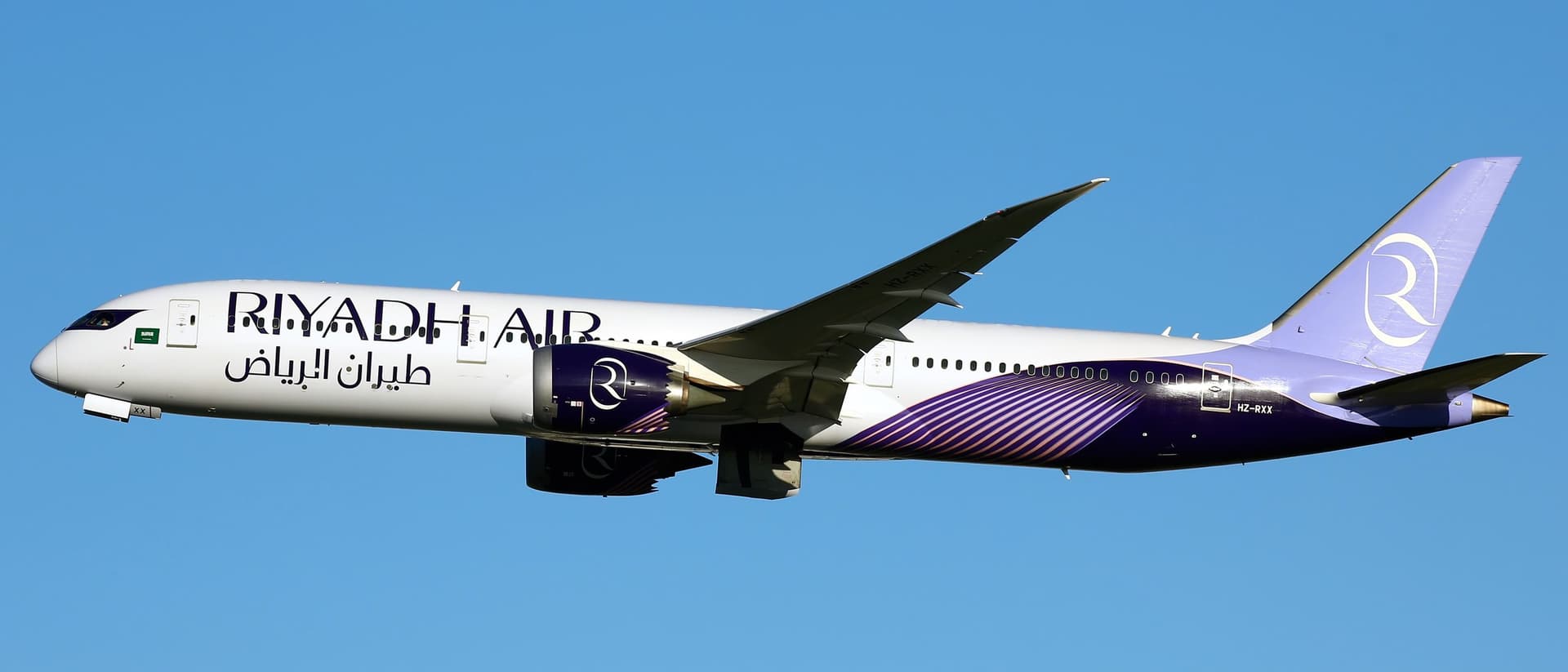
A jet in deep violet — a shade almost no other airline flies — landed at London Heathrow on June 10, and with it Saudi Arabia finally got its long-promised airline off the ground. Riyadh Air, owned by the Kingdom's Public Investment Fund, took its first Boeing 787-9s in early June and begins daily Heathrow service on July 1. It's the first all-new full-service carrier to join the Gulf's hub club in two decades.
For most of June the 787-9 has been flying inaugural runs — Jeddah, Dubai, Cairo, and London — with Madrid and Manchester to come in July. Every one of those flights is the same aircraft doing the same job: turning Riyadh into a place you change planes.
That job is the whole strategy. The Gulf's big three — Emirates in Dubai, Qatar Airways in Doha, Etihad in Abu Dhabi — built themselves on connecting traffic: flying you from one foreign country to another with a stop at their hub. Book London to Bangkok on Emirates and you change planes in Dubai. The airline never needed you to want to visit Dubai. It only needed Dubai to sit between where you started and where you were going. Riyadh wants that same role, a few hundred miles inland to the northwest.
The airplane up front
Start with the product, because Riyadh Air clearly wants you to. Its 787-9 seats 290 people across four cabins, and the front of the plane is the pitch.
The marquee is Business Elite: four suites in their own mini-cabin, built on the Safran Unity seat. You get a 78-inch lie-flat bed, walls 52 inches high, a sliding privacy door, and a 32-inch 4K OLED screen the airline bills as the largest in business class anywhere. The middle two suites combine into a double bed. Audio comes through speakers built into the headrest — a French Devialet system, so no headphones required.
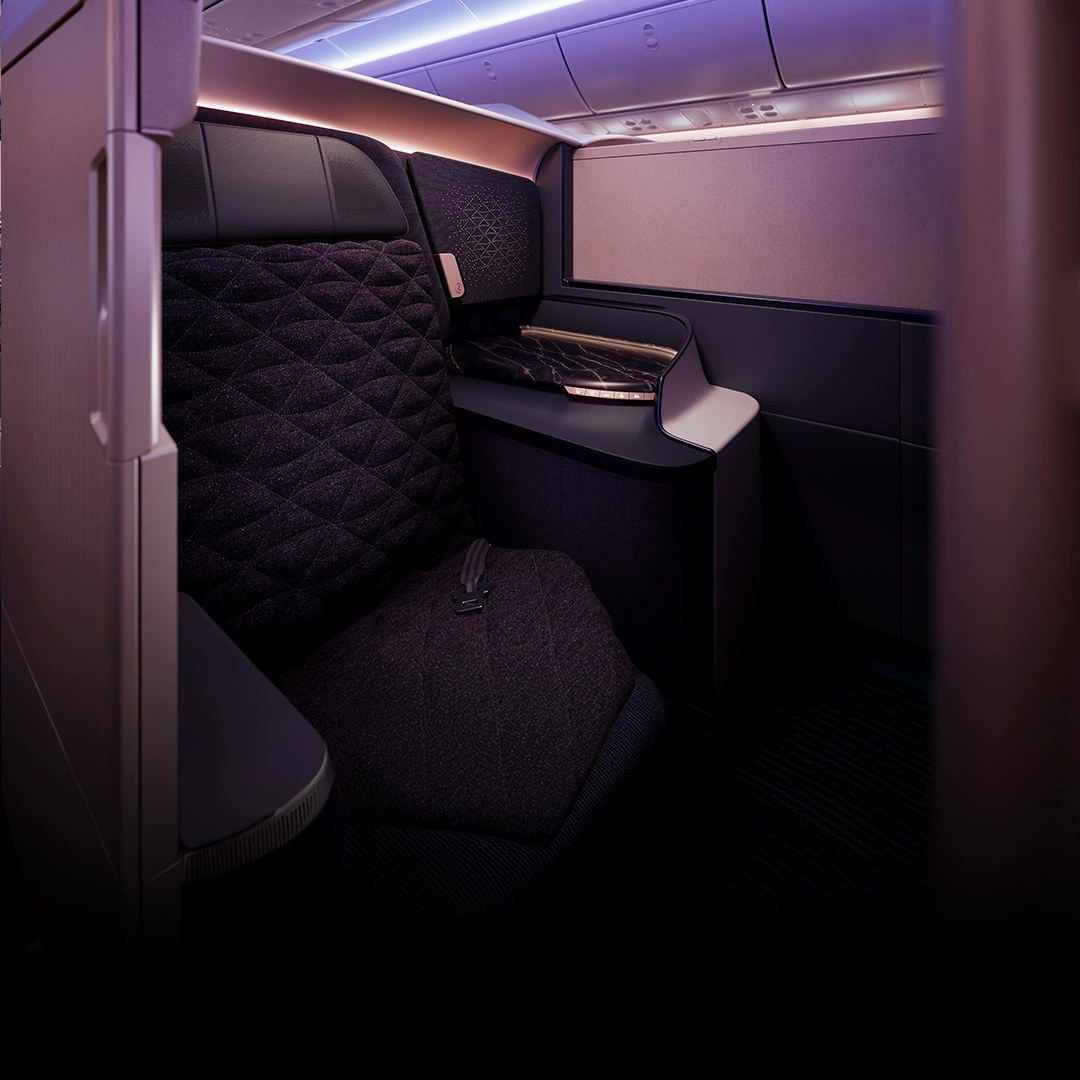
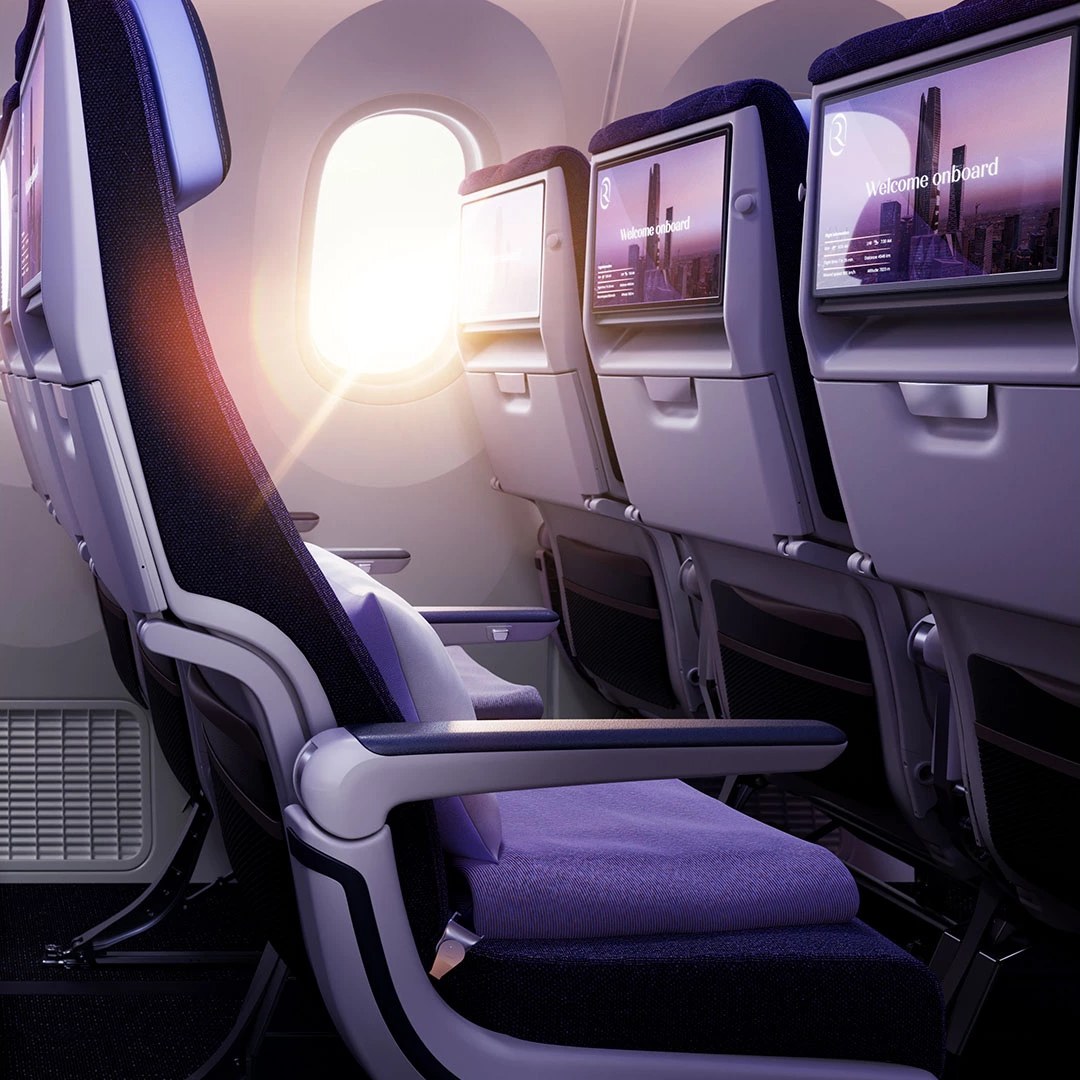
Behind that sits regular Business: 24 more Safran Unity suites, same seat, slightly smaller screen, same 1-2-1 layout where every passenger reaches the aisle without climbing over a neighbor. Premium Economy is 39 seats in a 2-3-2 layout, and Economy is 223 seats at 3-3-3. There is no first class — Business Elite is the top of the airplane. The cabins share a “canopy twist” motif meant to echo a traditional Arabic tent, which is a nicer way of saying the design has a point of view instead of a catalog look.
Where it flies, and how fast it's growing
The launch map is compact and deliberate: London and Manchester in the UK, Madrid in Spain, Cairo in Egypt, plus Dubai and Jeddah closer to home. All of it on the 787-9. Riyadh Air says it wants to reach about 22 cities by March 2027 and more than 100 destinations by 2030 — an aggressive ramp that depends on jets arriving on schedule.
They have a lot of jets coming. The order book runs to 124 firm aircraft and up to 182 with options: 39 Boeing 787-9s, 25 Airbus A350-1000s, and 60 Airbus A321neo narrowbodies. That last number is worth holding onto.
How it stacks up against the big three
On size, Riyadh Air isn't in the conversation yet — it's a three-airplane airline measured against carriers that move tens of millions of people a year. Emirates carried 53.7 million passengers last year, Qatar Airways 43.1 million, Etihad 22.4 million. Riyadh Air has carried passengers for three weeks.
The Gulf sits between Europe and Asia
- Riyadh
- Gulf hub
- Route endpoint
| Carrier | Hub | Passengers (FY2025) | Passenger fleet | Fleet shape |
|---|---|---|---|---|
| Riyadh Air | HubRiyadh (RUH→KSIA) | Passengers (FY2025)Launching | Passenger fleet3 now · 124 on order | Fleet shapeWidebody + narrowbody |
| Emirates | HubDubai (DXB) | Passengers (FY2025)53.7M | Passenger fleet~254 | Fleet shapeAll-widebody |
| Qatar Airways | HubDoha (DOH) | Passengers (FY2025)43.1M | Passenger fleet~227 | Fleet shapeMostly widebody |
| Etihad | HubAbu Dhabi (AUH) | Passengers (FY2025)22.4M | Passenger fleet~102 | Fleet shapeMixed |
What it has instead is a balance sheet that doesn't need to turn a profit on a normal schedule, and a starting position the others never had. Dubai's metro area is about 3.6 million people, so Emirates is nearly a pure connecting machine — most of the plane is heading somewhere other than Dubai. Saudi Arabia has roughly 34 million people, a business capital in Riyadh, religious travel through Jeddah, and a national plan to pull in 150 million visitors a year by 2030. There's real demand sitting underneath the hub, not just passengers passing through it.
The fleet says the same thing. Emirates flies zero narrowbodies; its model is widebodies funneling long-haul traffic through one airport. Riyadh Air ordered 60 single-aisle A321neos alongside its widebodies. That's an airline planning to fly a lot of point-to-point routes around the region, not only Europe-to-Asia connections through a single Gulf hub. It's a connector with a domestic airline attached — a slightly different animal than the three it's chasing.
The bet
The real venue hasn't opened yet. Today Riyadh Air flies from King Khalid International; its future home is King Salman International Airport, a Foster + Partners mega-hub with six runways that Saudi Arabia wants handling 100 to 120 million passengers a year by 2030. The airline, the airport, and the tourism targets are one Vision 2030 package, and they rise or fall together.
The honest caveat: the Gulf connecting market is crowded, and the margins on flying someone from London to Bangkok through your hub are thin. Three carriers already do it extremely well. But none of them launched with as much demand of their own to build on. Whether that's enough to make a fourth super-connector work is the question Riyadh Air spends the rest of the decade answering.
Explore the data
Agree or disagree?
Tell me what I missed, what you'd add, or where the argument breaks.