Spirit is gone. Here's the map of who actually won and lost.
The 'Spirit failed' headline writes itself. The interesting story is who got rewired — and the fact that most of Spirit's roughly 125 active aircraft will end up flying for international airlines, not American ones.
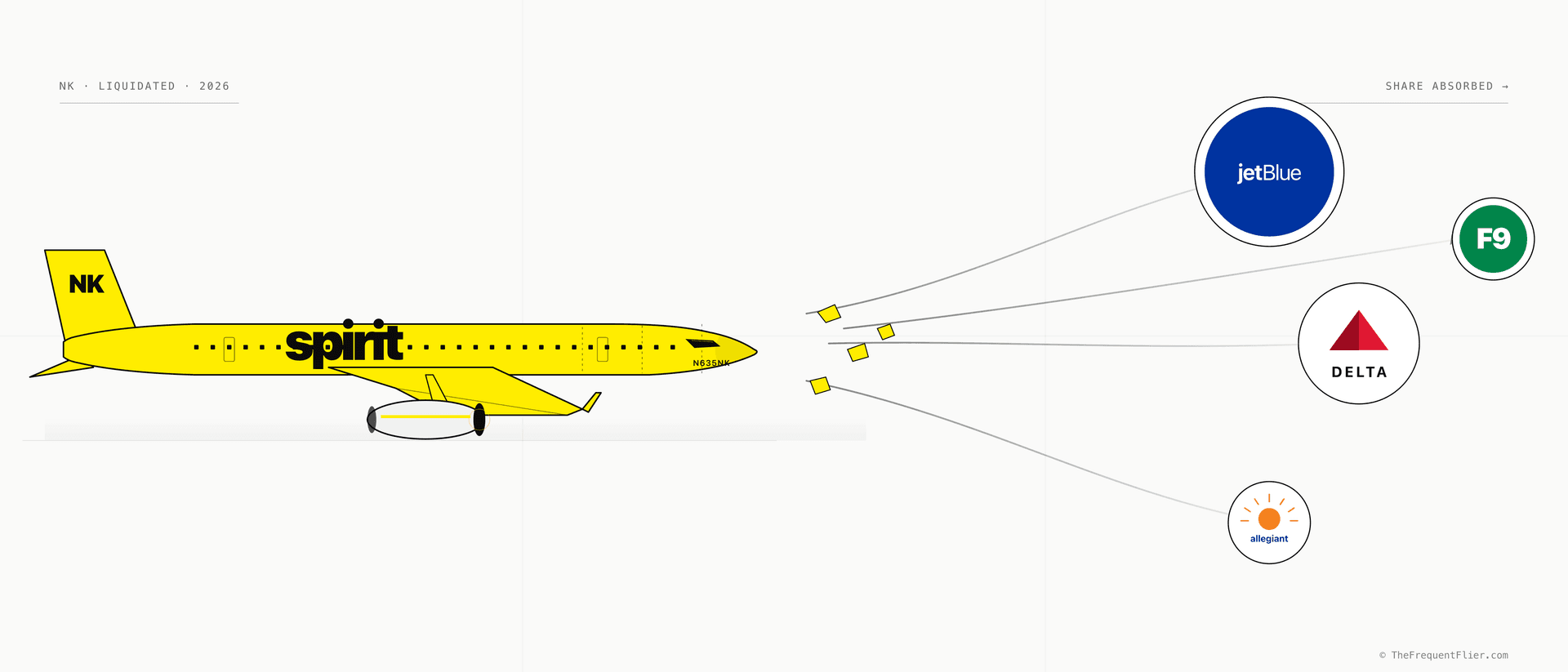
Spirit Airlines wound down operations on May 2. A $500M federal rescue package collapsed at the negotiating table. 17,000 jobs gone — 14,000 Spirit employees and 3,000 contractors. Spirit is the first major U.S. airline in 25 years to liquidate due to financial problems.
You've already read that story. So let me skip it and map what actually matters: who wins, who loses, and the one player everyone is calling a winner who should quietly be worried.
The winners
- JetBlue. By Q1 2026, Spirit's FLL share had fallen to ~24.5% while JetBlue's had climbed to ~22% — close enough that JetBlue's pre-existing growth plus Spirit's decline made the changeover inevitable even before liquidation. With Spirit gone, JetBlue is now unambiguously the king of FLL, and they're not being subtle about it: they've announced approximately 130 daily departures from Fort Lauderdale this summer, the largest operation in JetBlue's history at the airport. JetForward just got the pricing power it was hunting for.
- Delta. The quietest winner. Spirit was Detroit's #2 carrier with 11.3% share at Delta's second-largest hub. That share doesn't move to Frontier — it moves to Delta. Plus the LGA slot redistribution and the marginal pickups at ATL and EWR. None of it is loud. All of it shows up in the numbers.
- Allegiant. The disciplined ULCC operator that didn't blow itself up. Q4 2025 adjusted operating margin of 12.9%, raised 2025 profit guidance, growing capacity ~17% — but doing it without panic. Las Vegas is hometown turf, Spirit's LAS share was already down 53% year-over-year heading into liquidation, and Allegiant explicitly said Vegas margins were improving. They get the cleanest pickup of leftover ULCC demand.
- U.S. taxpayers. A $500M federal rescue was on the table and didn't get written. The market liquidated a structurally unprofitable carrier without a check from Washington. That's how this is supposed to work.
Tap any airport to see Spirit's share, the top competitors, and the likely winner.
ACY
- Spirit share
- 60%
- Top competitors
- Allegiant, Breeze, American
- Likely winner
- Partial — Allegiant + Breeze
FLL
- Spirit share
- 25.5%
- Top competitors
- JetBlue (25.4%), Delta (14%), Southwest (14%)
- Likely winner
- JetBlue
DTW
- Spirit share
- 11.3%
- Top competitors
- Delta (70%)
- Likely winner
- Delta
MCO
- Spirit share
- 10.7%
- Top competitors
- Southwest (20.6%), Delta (12%), JetBlue (11.7%), Frontier (9.6%)
- Likely winner
- Southwest + Frontier
LAS
- Spirit share
- 6%
- Top competitors
- Southwest (30%), Allegiant (10%), Frontier (5%)
- Likely winner
- Allegiant + Frontier
EWR
- Spirit share
- 4%
- Top competitors
- United (65%)
- Likely winner
- United
ATL
- Spirit share
- 3%
- Top competitors
- Delta (75%)
- Likely winner
- Delta
LGA
- Spirit share
- 3%
- Top competitors
- Delta (38%), American (24%)
- Likely winner
- Delta + American
IAH
- Spirit share
- 3%
- Top competitors
- United (75%)
- Likely winner
- United
The surprise winner: international airlines, not American ones
Here's the part nobody is writing yet. By liquidation, Spirit's active fleet had been pared to roughly 125 aircraft after a year of downsizing — and about 76% of them were leased. AerCap, SMBC Aviation Capital, and Jackson Square will redistribute almost all of them. But probably not within the United States.
Frontier — the only U.S. carrier with perfect type compatibility (100% A320 family) — is deferring 54 A320neo deliveries and returning 24 in Q2 2026. They don't want more aircraft. American, Delta, and United have fresh A321neo orderbooks and have no interest in 10-to-15-year-old A320ceos. The natural buyers are Latin American, European, and Asian operators facing manufacturer delivery delays.
The U.S. loses the capacity. The aircraft don't.
That reinforces the broader story: capacity exits the U.S. domestic market, surviving operators raise prices on overlapping routes, premium-heavy carriers barely notice. (Delta's Q1 2026 premium revenue was up 14% in the same quarter Spirit died.)
The losers
- 17,000 Spirit employees. Pilots and flight attendants will land somewhere. Ramp, GSE, and HQ staff face a much harder reset. The market doesn't care that they did everything right.
- The price-elastic traveler. Students, seasonal workers, immigrant families flying home — the segment Spirit was actually built for. Frontier absorbs some. Not all of it. And not at the same fares.
- Atlantic City and the small markets that won't recover. Spirit was the dominant carrier at ACY with about 60% of service across 6 direct routes; Allegiant and Breeze can backfill some, but ACY structurally loses routes. And don't forget what already happened: in September 2025, during Spirit's second bankruptcy, the airline cut 11 cities entirely — Albuquerque, Birmingham, Chattanooga, Columbia (SC), Oakland, Sacramento, San Jose, San Diego, Portland, Salt Lake City, Boise. Those routes are gone. Several of those markets had no other ULCC option, which means legacy-only service at higher fares from here.
The one everyone is calling a winner should be worried
Frontier is acting like the obvious heir. Rescue fares for Spirit customers, a $199 GoWild Summer Pass, nine new routes, fifteen additional daily flights into 18 former Spirit markets. The cheering on the analyst calls is going to be loud.
Frontier should be quietly terrified.
Until this past weekend, every U.S. ULCC management team operated on an unstated assumption: the federal government and the industry would not allow a major U.S. carrier to actually liquidate. There would be a Chapter 11, an extension, a lender of last resort, a quiet acquirer. That assumption just got falsified in public — the first time in 25 years. Frontier now flies with the same fuel curve, the same thin margins, and the explicit, demonstrated knowledge that nobody is coming if they crack.
That changes how a board has to think about every capital allocation decision from here. It's a gift, if Frontier reads it correctly. It's an obituary draft, if they don't.
What this actually teaches
The clean lesson isn't really about Spirit. It's about how the U.S. airline market behaves when nobody intervenes.
A structurally unprofitable carrier ran out of runway during a fuel shock and was allowed to fail. Capacity exits. Surviving operators raise prices on overlapping routes. Premium-heavy carriers — the ones with corporate revenue and co-brand cash flow — barely notice. Price-elastic travelers lose options.
That's not a failure of the system. That's the system working. For better, and for worse.
Explore the data
Agree or disagree?
Tell me what I missed, what you'd add, or where the argument breaks.