United's New Flight Attendant Deal: How It Compares to American's and Delta's, and What It Costs UAL
United settled with its 30,000 flight attendants on May 12 — a 31% raise, boarding pay for the first time, and $741 million in retro. Here's the deal in context: side by side with American's 2024 APFA contract and Delta's non-union compensation path, plus what the contract costs UAL's bottom line.
What United agreed to
United flight attendants ratified their new five-year contract on May 12, 2026, with 82% yes on close to 90% turnout. The terms:
- 31% base raise, compounded across June and August 2026
- Boarding pay introduced for the first time at UAL — adds 7–8% to overall compensation
- $741 million in retroactive pay, a one-time 2026 charge
- Quality-of-life provisions: red-eye restrictions, sit-pay for delays over 2.5 hours, 14-hour Reserve Availability Periods (replacing 24-hour on-call), 10 weeks paid maternity leave
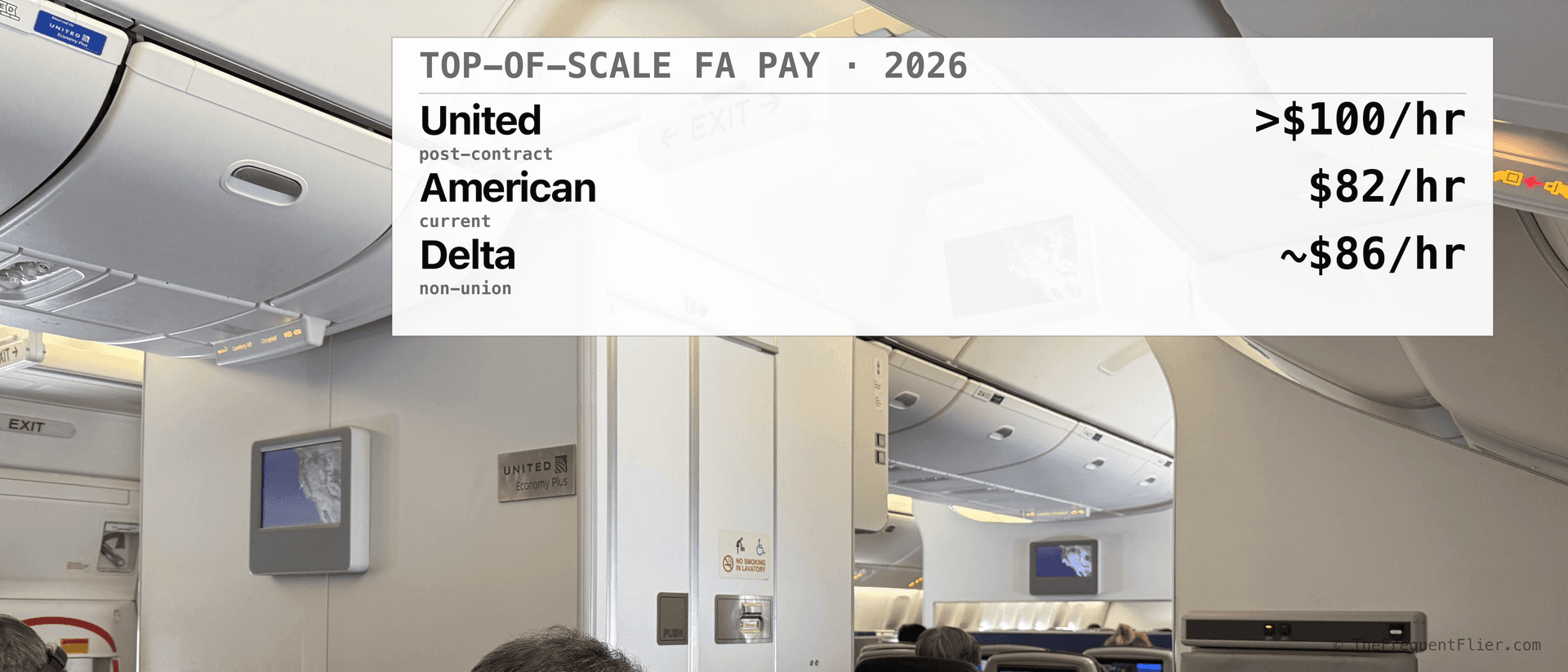
- Top-of-scale post-contract: above $100/hour
The deal becomes amendable around May 2031.
How that compares to American's APFA deal
APFA at American Airlines ratified its current five-year contract on September 12, 2024, with wage increases effective October 1, 2024. The terms:
- Immediate raises graduated by seniority: 18% for years 1–6, 19% for years 7–12, 20.5% for 13+
- Boarding pay introduced effective April 1, 2025 at 50% of hourly rate — the first unionized FA workforce in the US to lock it in
- $514 million one-time retro charge in Q3 2024
- Total contract value: $4.2 billion over five years (~$840 million annual run-rate)
- Top-of-scale post-deal: $82.24/hour at 13+ years, reaching above $92/hour by year five
- Years 2 through 5 escalators: 2.75%, 3%, 3%, 3.5%
So United's deal is structurally heavier on the front end than American's. The immediate raise is bigger (31% vs. 20.5%). The retro is bigger ($741 million vs. $514 million). The headline top-of-scale already exceeds where APFA lands at the end of its contract ($100+/hour vs. $92/hour). Some of that reflects United settling 20 months after American on the calendar — by the time UAL got to ratification, APFA's precedent had set the floor and the AFA-CWA had leverage that wasn't available to American's negotiators in 2024.
Delta's path didn't go through a union
Delta is the outlier. AFA-CWA failed to organize Delta flight attendants in 2010 and again in 2024. Delta has kept ahead of the labor cycle by raising pre-emptively:
- 4% in May 2022
- 5% in April 2023
- 5% in June 2024
- 4% in June 2025
- Another 4% announced in February 2026
By Delta's own accounting, cumulative investment in flight attendant compensation since 2022 totals 25% or more — that's the compounded sequence above plus base wage scale increases (Delta also raised its starting hourly rate to $19/hour in 2024).
Delta also pioneered boarding pay in June 2022 — the first major US carrier to introduce it, at 50% of the regular hourly rate.
Top-of-scale at Delta in 2026 sits around $85–87/hour. That's below UAL's post-contract $100+/hour and roughly even with APFA's current $82/hour. The non-union path delivered less headline wage than either union deal, but it did so without retro charges, without a ratification ceremony, and without a contract amendable date. Delta's flight attendants kept the operational flexibility a unionized work group has to negotiate for; the company kept the timing flexibility a union calendar takes away.
Ratified
- United (UAL)
- May 12, 2026
- American (AAL)
- Sept 12, 2024
- Delta (DAL)
- (non-union — pre-emptive raises)
Immediate raise
- United (UAL)
- 31%
- American (AAL)
- 18–20.5% (graduated)
- Delta (DAL)
- ~25% cumulative since 2022 (per Delta)
Boarding pay (first introduced)
- United (UAL)
- May 2026
- American (AAL)
- April 2025
- Delta (DAL)
- June 2022 (industry-first)
Retroactive pay
- United (UAL)
- $741M
- American (AAL)
- $514M
- Delta (DAL)
- —
Top-of-scale (post-deal, 2026)
- United (UAL)
- >$100/hr
- American (AAL)
- $82.24/hr (→ $92+/hr by year five)
- Delta (DAL)
- ~$85–87/hr
Headcount
- United (UAL)
- ~30,000
- American (AAL)
- ~28,000
- Delta (DAL)
- ~28,000 (non-union)
Contract amendable
- United (UAL)
- ~May 2031
- American (AAL)
- Oct 2029
- Delta (DAL)
- (no amendable date)
What it costs United
The annual run-rate cost of United's contract lands in the $1.0–1.2 billion range. Triangulating: ~30,000 flight attendants × roughly 31% on top of a ~$2.4 billion baseline payroll, plus boarding pay at 7–8% of total compensation, plus benefits loading and the quality-of-life provisions.
For comparison, American's APFA deal averages roughly $840 million per year over the five-year window (the $4.2 billion total contract value divided by five). United's run-rate is meaningfully higher because the raise magnitudes are bigger and UAL has a larger flight attendant headcount.
Management said on the Q1 2026 earnings call that the cost is already baked into 2026 EPS guidance of $7 to $11 per share. So the contract doesn't change the published outlook for this year — but it does close the question of what United's labor cost base looks like going into 2027, when the deal sits at full run-rate against revenue that's still working back from the fuel cycle.
The takeaway
Three different paths to roughly comparable destinations. American went first and locked in industry-leading terms in 2024. Delta sidestepped the cycle with pre-emptive raises and boarding pay starting in 2022. United waited longest and paid the most when it finally settled — both in retro and in immediate raise size. None of the three carriers have a flight attendant pay problem heading into 2027. They got there on different timelines, with different friction costs, and with materially different residual flexibility.
Explore the data
Agree or disagree?
Tell me what I missed, what you'd add, or where the argument breaks.