The Biggest World Cup Ever Is Here. U.S. Airlines Added 0.6% More Seats.
Forty-eight teams, 104 matches, three countries. For the largest sporting event ever held in North America, U.S. carriers grew June–July capacity by less than a percent — and the high-value international fan they would add seats for is the part of the crowd that didn't show.
The World Cup opened on June 11 and runs through July 19: 48 teams, 104 matches, 16 cities across the United States, Mexico, and Canada. It's the biggest tournament the sport has ever staged, and most of the people watching in person had to fly to get there.
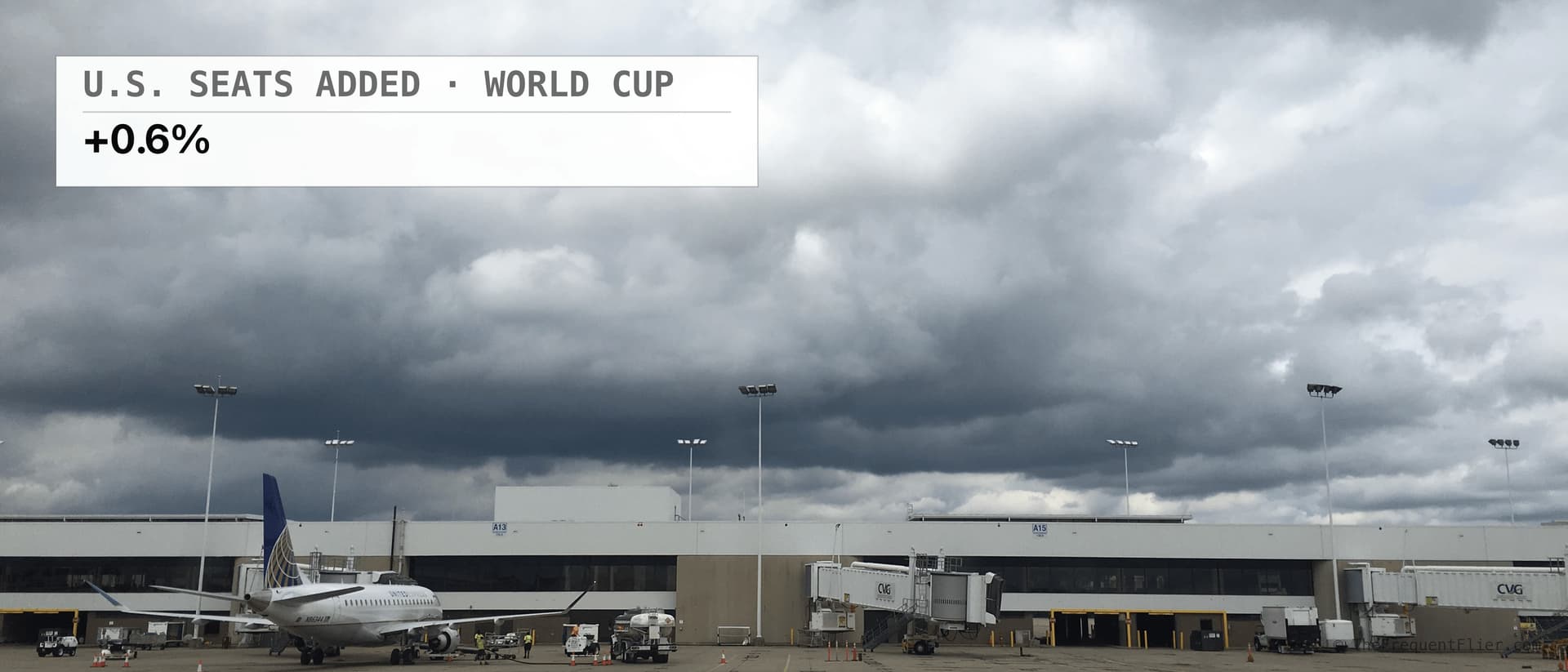
Here's the number that matters for the airline business. Scheduled seats to the three host countries this June and July are essentially flat against last year. In the United States — a market about ten times the size of Mexico's or Canada's — capacity is up roughly 0.6%. Canada added 4%. Mexico barely moved. For the largest event the continent has ever hosted, the airlines added almost nothing.
That isn't a failure to plan. It's the plan.
How airline capacity moved for the World Cup
Year-over-year seat capacity · June–July 2026 vs 2025
Start with the calendar. June and July are already the busiest weeks of the year for flying to North America, when American summer breaks overlap with European ones. Planes in those months routinely go out more than 90% full, and fares sit at their annual high. A carrier looking at a 92% load factor doesn't need more passengers to profit from the World Cup; it needs higher fares on the seats it already sells. Adding capacity into a peak that's already selling out is how you turn a high-fare summer into a planeload of empty seats.
The industry also has a fresh cautionary tale. Air France added flying for the 2024 Paris Olympics, watched demand arrive softer than the hype promised, pulled the extra capacity back, and still took a revenue hit it later pegged at around €160 million. Every network planner filed that away. Big events tend to push out as much ordinary travel as they pull in — residents leave town, business traffic thins, the casual tourist books a cheaper week somewhere else. The disciplined move is to hold the schedule and price into the demand, not to fly at it.
They couldn't fly at it very hard anyway. Boeing and Airbus are still behind on deliveries, and airlines have almost no idle aircraft to throw at a six-week event. So what moves for the World Cup is mostly reshuffled, not added. Mexico is the clearest case: carriers pushed about 727,000 seats toward the three host cities, roughly 373,000 of them into Mexico City's two airports, while seats to the country's beach resorts fell 3.6%. The planes came off the leisure routes. They weren't new.
For the airlines, the World Cup is a pricing event, not a capacity event.
The stadiums, to be clear, are full — the tournament broke the all-time World Cup attendance record inside its first week. But look at who's filling them: heavily domestic fans, buying the cheapest ticket tiers. The part of the crowd an airline actually schedules a widebody for, the overseas visitor flying in for a week, is the part that's soft. Bookings from Europe to the U.S. for July were running down about 14% year over year in the early window, Frankfurt off more than a third. Host-city hotels have been cutting their game-day room rates rather than raising them — New York City's hotel association said plainly that FIFA's promised boost hadn't arrived, and FIFA itself quietly released thousands of the rooms it had blocked.
New York
- Late 2025
- $609
- April
- $464
- Change
- −24%
Boston
- Late 2025
- $612
- April
- $486
- Change
- −21%
Dallas
- Late 2025
- $274
- April
- $217
- Change
- −21%
Philadelphia
- Late 2025
- $301
- April
- $245
- Change
- −19%
San Francisco
- Late 2025
- $289
- April
- $236
- Change
- −18%
Los Angeles
- Late 2025
- $386
- April
- $340
- Change
- −12%
Atlanta
- Late 2025
- $215
- April
- $197
- Change
- −8%
Miami
- Late 2025
- $256
- April
- $235
- Change
- −8%
Houston
- Late 2025
- $193
- April
- $184
- Change
- −5%
Seattle
- Late 2025
- $311
- April
- $303
- Change
- −3%
Kansas City
- Late 2025
- $217
- April
- $214
- Change
- −1%
The reasons are stacked against the long-haul fan in particular. Match tickets are running five to twenty times Qatar 2022 prices; following one team to the final starts around $6,900 before a single flight or hotel night. More than half the qualifying countries need U.S. visas, and the broader mood around traveling to the U.S. this year has been wary. The high-spending international visitor an airline would lay on a summer of extra widebodies for is exactly the one staying home.
For a traveler, the result is the split market the data firm OAG called "a game of two halves." Getting to the United States is, if anything, a little cheaper this summer: Europe-to-U.S. capacity is up 4%, demand is soft, and economy fares to eight of the host cities were running below last year earlier in 2026, Kansas City the cheapest of them. Moving between host cities is where the World Cup tax lands — the lowest fares from Dallas, Miami, and Philadelphia to the other host cities were up more than 50% earlier this year. If you're holding a match ticket and no flights, the Paris pattern says transatlantic fares could sag closer to the day. That's a real gamble with a seat to a final on the line.
None of this means the World Cup is small. It means the airlines decided how they wanted to play it. They aren't adding seats; they're adding fares — and so far, the crowd that showed up is mostly the crowd that was already here.
Agree or disagree?
Tell me what I missed, what you'd add, or where the argument breaks.