Spirit's LaGuardia Slots Sold for $58.5 Million. Its Pricing Systems Drew $10 Million, Then $12.5 Million.
The estate has sold an office building, a maintenance hangar, and 22 takeoff and landing rights at LaGuardia. The cheapest thing on the list is the only one anybody is fighting about.
If you flew Spirit, your points stopped being worth anything on May 2, and you are now an unsecured creditor in a bankruptcy case in lower Manhattan. If you worked there, your email is an asset the estate is trying to sell.
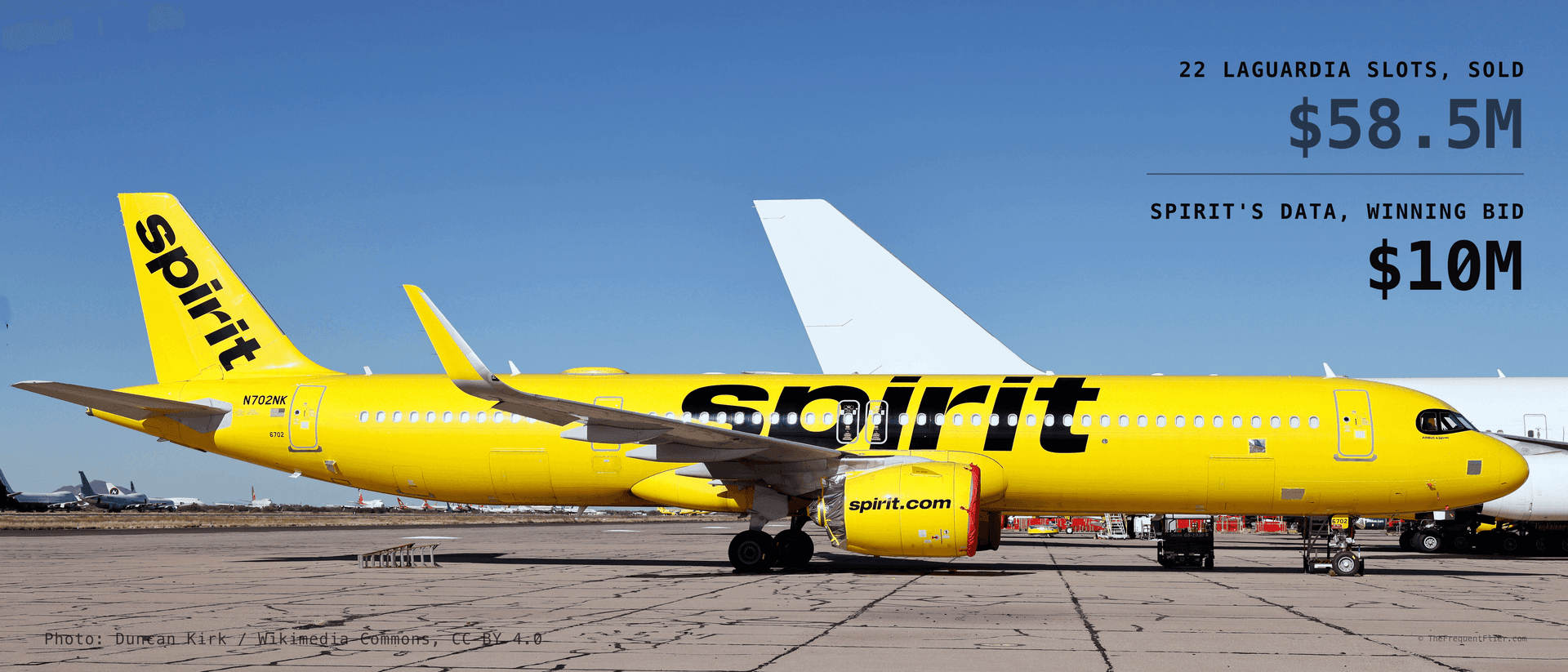
On August 14, Spirit's estate told the court that Google had won an auction for the airline's internal business data at $10 million. The backup bidder, at $7.5 million, was Mercor, an AI company whose business is recruiting human experts and sourcing human-generated material for AI labs.
Four days later the hearing to approve that sale was adjourned to September 9, after the Association of Flight Attendants-CWA objected. Google has not bought anything yet, whatever the headlines say. Its own statement, which opens "We acquired part of an enterprise dataset from Spirit Airlines," is running a little ahead of the docket.
Two days after that, a third AI company put a number on the same archive. Micro1, a Palo Alto data-labeling firm that recruits human experts to train models — the same business Mercor is in — sent Spirit's lawyers a $12.5 million offer on August 20, a quarter above Google's winning bid and well after the auction had closed. Its founder, Ali Ansari, told reporters Google's price was "actually quite low." The estate has not said whether it will entertain the offer, and there is no confirmation it has reached the docket. The winning bid is still $10 million.
What Spirit's estate has sold, by price
Only the things Spirit couldn't make more of held their price
Spirit stopped flying at 3 a.m. on May 2. Since then its estate has been doing something an airline never does while it is alive: pricing each piece of itself separately, in public, with a judge watching.
Four non-aircraft sales have come to auction. The Dania Beach headquarters campus drew $93.25 million from Hill City Capital — a six-story office building, a flight simulator facility and an amenity block that together cost around $250 million to build. Twenty-two LaGuardia slots went to JetBlue for $58.5 million. Spirit's largest maintenance hangar, 126,000 square feet at Detroit, fetched $18 million from the airport authority itself, the only qualified bidder that showed up. The data came in at $10 million.
Read that list by what each asset is. The building is land in South Florida. The slots are federally rationed permission to use a runway at a specific minute. The hangar is a ground lease on airport property. Not one of them is something Spirit could have produced more of by trying harder.
The data is the opposite. Spirit manufactured it continuously, as a byproduct of operating, across the eighteen years the archive covers. Every fare it filed. Every fare it watched a competitor file. Every model it built of how a flight fills up, every line of code it wrote to price a bag.
The sale schedule, as reported from the August 14 filing, puts numbers on that. Roughly 30 million lines of code across 516 repositories. Around 7.5 billion transactions going back to 2008. Another 7.25 billion observations of what competitors were charging, going back to 2021. And 100 million emails across 80,000 accounts.
That is the operating memory of a company that carried 25.2 million passengers in the twelve months through May 2026, its last year of flying. It is the cheapest thing on the list.
Revenue management is the function airlines point to when they explain why one carrier survives a fuel shock and another doesn't. Spirit's estate ran a real auction for exactly that capability, with motivated buyers and a public docket, and the clearing price came in below a fifth of what twenty-two takeoff and landing rights fetched. Access is scarce. Knowing how to use it, apparently, is not.
Two bidders, a wind-down clock, and a thin price
An auction with two qualified bidders and a wind-down clock behind it produces a thin price. That is the first thing to say about the $10 million, and it is fair. A dead company's revenue management system has no obvious buyer — you cannot run it, and the fare environment its models learned no longer exists, in part because Spirit's own capacity came out of it. The two who bid on time were an AI lab and an AI data broker; the one who missed the deadline was a second data broker. None of them wanted it for aviation.
The comparison still holds, because every asset on that list went through the same process. Same estate, same clock, same distressed buyers, same judge. The slots sold at a discount too. Spirit appraised them at $86.7 million and got $58.5 million, with the Port Authority arguing in court that they were not Spirit's to sell in the first place, and Frontier underbidding JetBlue by a single million. The headquarters went to a bidder who was not even the high bidder: a $97 million offer from someone else would have left the estate with less once it paid Hill City the fee it was owed for setting the floor. That is worth holding onto when a late higher offer appears: on this estate, one has already been passed over.
What JetBlue bought at that price was the New York operation of a carrier running ahead of it at the same airport. Over the twelve months through May 2026, Spirit carried 1.65 million passengers at LaGuardia on 4,983 departures. JetBlue carried 1.14 million on 4,325, according to The Frequent Flier's traffic database, built on the Transportation Department's T-100 filings. Spirit's two busiest LaGuardia routes ran to Fort Lauderdale and Detroit.
A 1978 statute, an archive it never imagined
The sale is proceeding under Section 363 of the Bankruptcy Code, written in 1978 to govern how a company in bankruptcy sells assets outside the ordinary course of business. Section 363 does carry a privacy mechanism. A trustee may not sell personally identifiable information unless the sale squares with the company's own privacy policy, or unless the court appoints a consumer privacy ombudsman and then approves the sale after "giving due consideration to the facts, circumstances, and conditions." The ombudsman has no veto.
The narrower problem is what the Code counts as personally identifiable information in the first place. Section 101 defines it as what an individual hands over "in connection with obtaining a product or a service from the debtor primarily for personal, family, or household purposes." That describes a customer buying a ticket. It does not describe an employee, and a payroll file is not something anyone submitted in order to fly somewhere.
Spirit's customers landed inside the definition and were carved out of the sale anyway. The schedule excludes 97.5 million customer profiles, 50.2 million Free Spirit accounts and 740,000 co-branded cardholders. Google's spokesperson said the company "will not receive any personal information from this dataset," and that a third party will scrub it before delivery. With the customer profiles gone, the ombudsman provision has nothing left to bite on.
Spirit's employees were never inside it. Employee records for about 175,000 people sit on the included side, the oldest dating to August 1986. So do 3.4 million payroll records. So do 500 million Microsoft Teams items. The union's objection names what lives inside them: disciplinary records, training deficiencies, and medical and accommodation requests.
The mechanism matters more than the volume. Both purchase agreements require the data to be de-identified "while preserving referential integrity across the data set" — the links between records survive the scrubbing, which is what makes a dataset useful and also what makes it reconstructable. The union's filing puts it plainly: with a group the size of Spirit's flight attendant population, "it may be possible that information about identifiable individuals or small identifiable groups can still be reconstructed and determined."
I have argued in this space that airline unions cost the industry more operating flexibility than they win back for their members. That is a claim about labor economics and it has nothing useful to say here. Sara Nelson called the sale outrageous. The objection her union filed is a narrow technical argument about whether de-identification survives contact with a workforce small enough to be re-assembled, and on that question the AFA is the only party in the room with both the standing and the incentive to raise it.
As of today no regulator has appeared in the case. No state attorney general, no FTC, no privacy authority. The objection on the docket is the union's.
Every airline you have worked for still holds your email, your Teams history, your training file and your payroll record. Spirit's flight attendants are the ones finding out what happens to all of it when the company holding it stops existing, and they are having to build the argument from scratch.
Explore the data
Agree or disagree?
Tell me what I missed, what you'd add, or where the argument breaks.