American's Seatback Screen Reversal Is What Nine Years Without a Product Strategy Costs
The airline is still pulling screens out of its oldest Airbuses this summer. In 2028 it starts putting them back into the same airframes, after nine years of arguing the opposite.
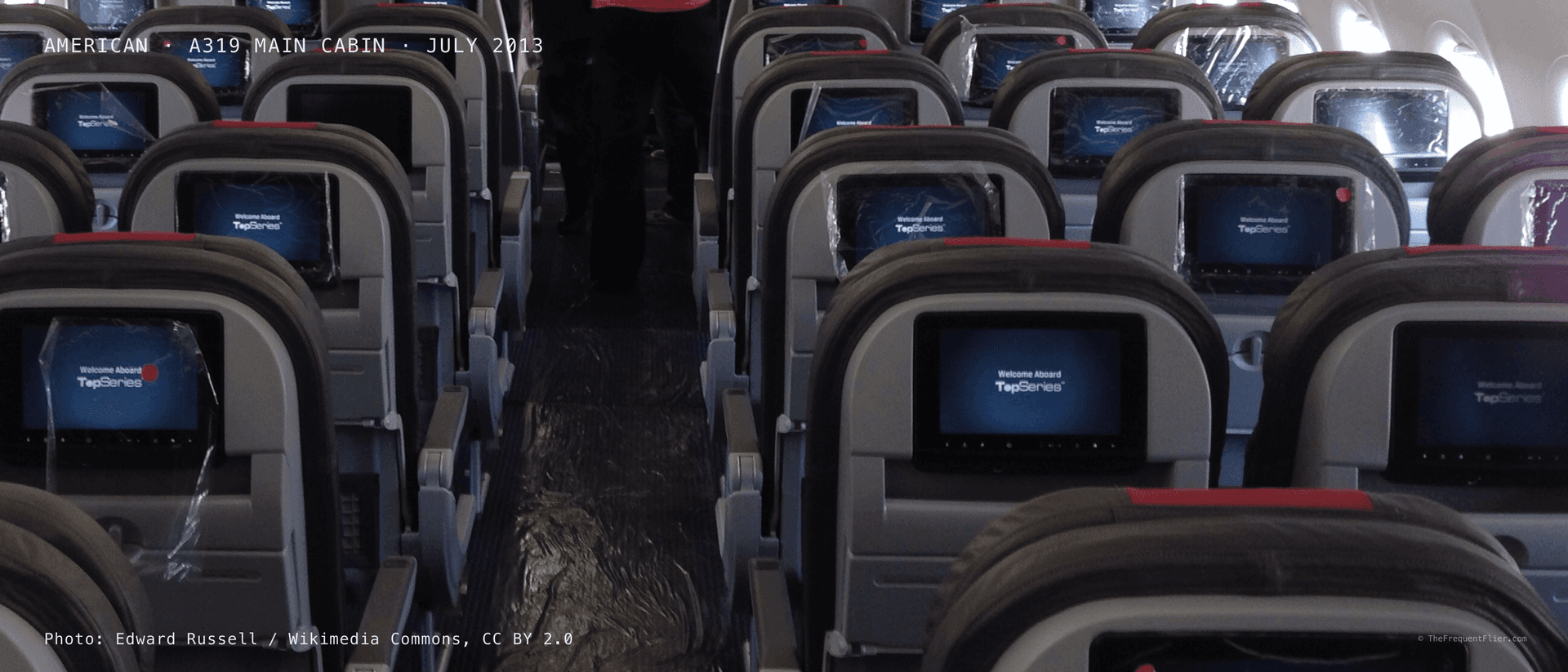
Twenty-three of the 32 American Airbus A319s that still carried seatback screens have had them stripped out this year. The last nine are expected to finish by the end of the summer. None of those aircraft are leaving the fleet — American pushed their retirement from 2026 to at least 2030.
On August 18, American announced “a sweeping transformation across its narrowbody fleet: installing state-of-the-art seatback entertainment screens at every seat.” New Airbus and Boeing deliveries carry them from 2028, and retrofits of the existing fleet run into the early 2030s. The release does not say which subfleets get retrofitted or when. Premium seats go from roughly a quarter of narrowbody seats to roughly 40%. Starlink lands on those same narrowbodies in 2027.
The one retrofit American does describe in detail is the one already running. “American is currently retrofitting its Airbus A319 and A320 fleets to add an additional row of First Class,” the release says. That is the same shop visit taking the screens out.
Read the order of operations again. Screens out in 2026, satellite internet in 2027, screens back in 2028.
The 2017 reasoning holds up
When American said in January 2017 that its 100 new 737 MAX jets would fly without seatback screens, it made an argument rather than an excuse. “More than 90 percent of our passengers already bring a device or screen with them when they fly,” the airline said at the time. “Those phones and tablets are continually upgraded, they’re easy to use, and most importantly they are the technology that our customers have chosen.” Money was better spent on entertainment and fast connections than on seatback monitors “that will be obsolete within a few years.”
Nine years on, that prediction reads as plainly correct. A 2017 seatback unit is slower and dimmer than a four-year-old phone. American is now buying 4K panels that will look tired by the time the program finishes reaching the back of the fleet.
American never funded the second half
Bring-your-own-device only works if the device experience is good: fast connectivity, power at every seat, room enough to look at the thing. American went the other way. Project Oasis pulled the screens out of the 737-800s and A321s and bolted device holders to the seatbacks in their place. In May 2017 the airline laid out a MAX cabin with three rows at 29 inches of pitch, retreated to a 30-inch minimum that June after customers and crews objected, and paid for the retreat by cutting extra-legroom seats from 36 to 30. Free satellite Wi-Fi, the substitute American had named in 2017, did not reach AAdvantage members until January 2026.
The 2017 strategy was never really tested. American announced a plan that depended on connectivity and comfort, underinvested in both for nine years, delivered the connectivity half in January 2026, and abandoned the plan seven months later.
Two answers to one question
American already delivers what the 2017 memo promised. Free satellite Wi-Fi reached 100% of the narrowbody fleet in January 2026, fast enough to stream, feeding the device in your hand that already knows what you watch. Starlink makes it faster still in 2027. Then from 2028 the airline spends four more years bolting 4K panels onto the seatbacks in front of it. That is two answers to one question.
I have never finished a flight wishing I’d had a second screen. When the Wi-Fi is good my laptop beats anything American will hang on a seatback, and if the connection is good enough to load the seatback library, it is good enough to load mine.
The strongest case for screens has little to do with entertainment. A phone playing a movie cannot also answer a message or open a spreadsheet, and on a four-hour flight most people want to do both. Screens work with a dead battery, without a subscription, and gate to gate. They carry content the streaming services geo-block. A family with three kids and two iPads notices. And a screen is legible in a way a connectivity contract is not, which matters when a corporate travel manager is comparing American against Delta and United on a spreadsheet. The same logic is moving the premium seat mix from 25% to 40% in this announcement, and that mix is a revenue decision with arithmetic behind it. The screens are riding along.
All of that argues for American having screens. None of it explains removing them through 2026 and reinstalling them from 2028.
Aircraft with seatback screens
Against each carrier’s US mainline fleet
Delta flies seatback screens on more than 900 aircraft out of a mainline fleet of 992, United on more than 800 out of 1,058. American has about 140, all of them widebodies, against 1,016 — 879 of which are narrowbodies, per our fleet database. That gap explains the announcement. It does not explain the decade American spent getting there: ahead of both rivals on the analysis in 2017, unwilling to fund the product that analysis required, and now buying its way back to parity on the thing it abandoned first.
Robert Isom was president of American Airlines in January 2017, when it decided to take the screens out. He is chief executive now that it is putting them back.
Explore the data
Agree or disagree?
Tell me what I missed, what you'd add, or where the argument breaks.