Why Southwest's First Lounges Aren't Where Southwest Is Biggest
Four lounges open in Austin, Baltimore, Honolulu, and Nashville in late 2027. Six larger Southwest stations get nothing. Chase already has Sapphire Lounges at two of those six.
Every lounge I got into for the first stretch of my flying life, I got into by flying. Status did it, or a business-class ticket did it, and the door opened on revenue I had already handed over. Somewhere in the last decade that stopped being the main way in. The door is a card now, and the card is the product.
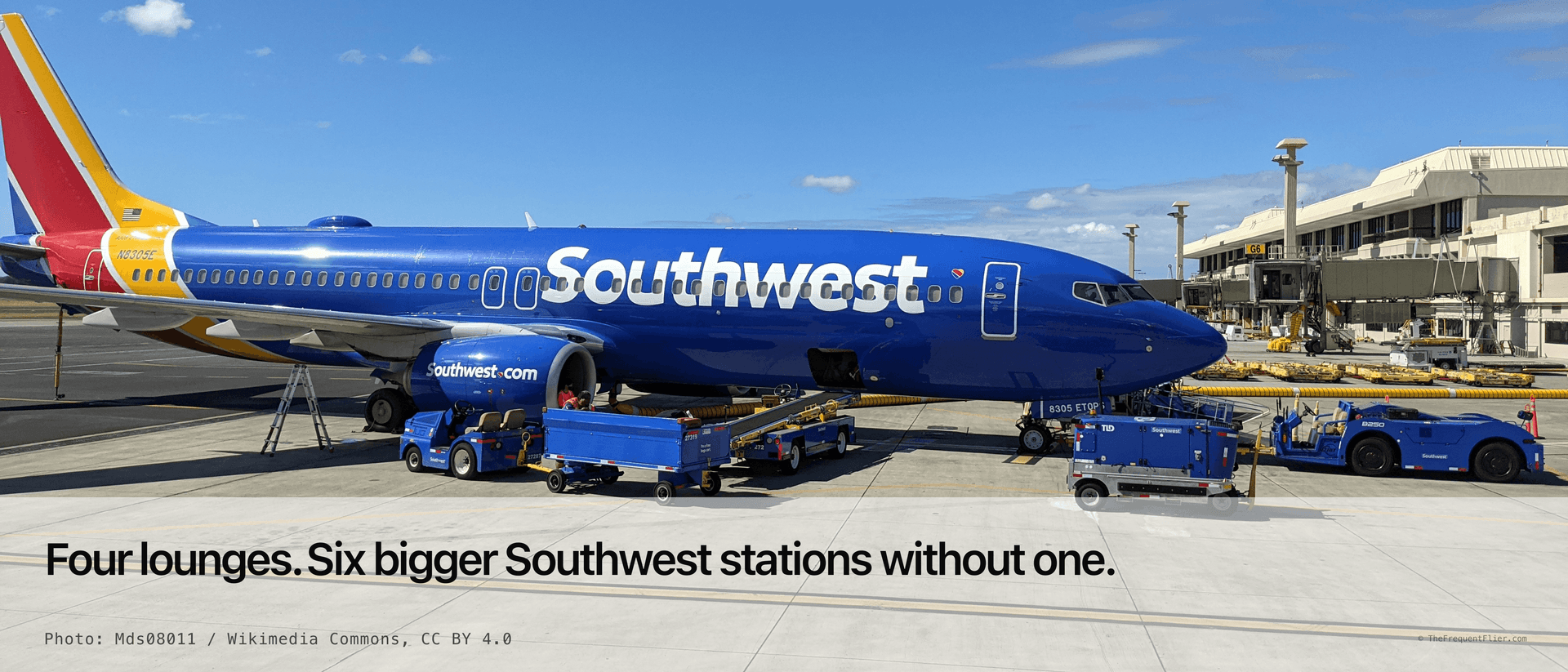
Southwest announced its first lounges on Wednesday. Four of them, in Austin, Baltimore, Honolulu, and Nashville, with construction underway and openings targeted for late 2027. At least seven more are promised after that, at airports the airline hasn’t named. The way in is a new premium Rapid Rewards card issued by Chase, launching in 2027, a year that starts before the rooms open.
Southwest hasn’t published the card’s annual fee, and it hasn’t described who will operate the rooms.
Where Chase already has a room
Southwest’s biggest station by departures is Denver, and Denver isn’t getting a lounge. Neither is Las Vegas, Chicago Midway, Phoenix, Dallas Love, or Houston Hobby.
Baltimore and Nashville do get one, and both are genuinely large for Southwest: third and seventh by departures over the twelve months through May 2026, per The Frequent Flier’s traffic database, built on the Transportation Department’s T-100 filings. Austin and Honolulu are the odd entries. Austin ran 38,549 Southwest departures in that window, behind Houston Hobby’s 54,030. Honolulu ran 12,259. Southwest is the third-largest carrier there, behind Hawaiian and Alaska, and its seats are down 12.2% year over year.
Now put Chase’s own lounges on the same map. It runs a Sapphire Lounge at Las Vegas and another at Phoenix, Southwest’s second- and fifth-largest stations. It has none at Austin, Baltimore, Honolulu, or Nashville.
Southwest's largest stations, and where the lounges are going
The four cities are where the partnership has a hole. A second room in Las Vegas or Phoenix would spend money on a cardholder who can already sit down.
The map belongs to both companies
This is what a mature co-brand looks like. The airline brings the traffic and the brand. The bank brings the capital and the reason to pay an annual fee. The asset gets sited against their combined footprint rather than either one’s alone.
Honolulu is the clearest case. On Southwest’s network it is a shrinking outstation carrying 15% of the airport’s departures. On a premium card’s map it is a high-spend leisure destination where a bank would like its name on the door. Both of those are true at once, and only one of them would have justified the build.
Anyone who spent years earning airline status should look hard at the access rule. Southwest has named the card as the way in, and it hasn’t said whether A-List or A-List Preferred carries any access of its own. Until it does, the fastest route into a Southwest lounge looks like an annual fee rather than a flown mile. None of the three largest US carriers admits domestic elite status to its clubs on status alone. Southwest would be joining a settled convention. It is still a change for the airline that spent more than fifty years selling the opposite.
The card lands sometime in 2027. The first four rooms open late that year. Southwest hasn’t named the other seven, and Denver, Las Vegas, Midway, Phoenix, Dallas Love, and Houston Hobby are all still on the table.
Explore the data
Agree or disagree?
Tell me what I missed, what you'd add, or where the argument breaks.