Why Delta Turned Down a Merger With United
Scott Kirby went to Delta before he went to American. The two networks barely overlap, and Delta still said no.
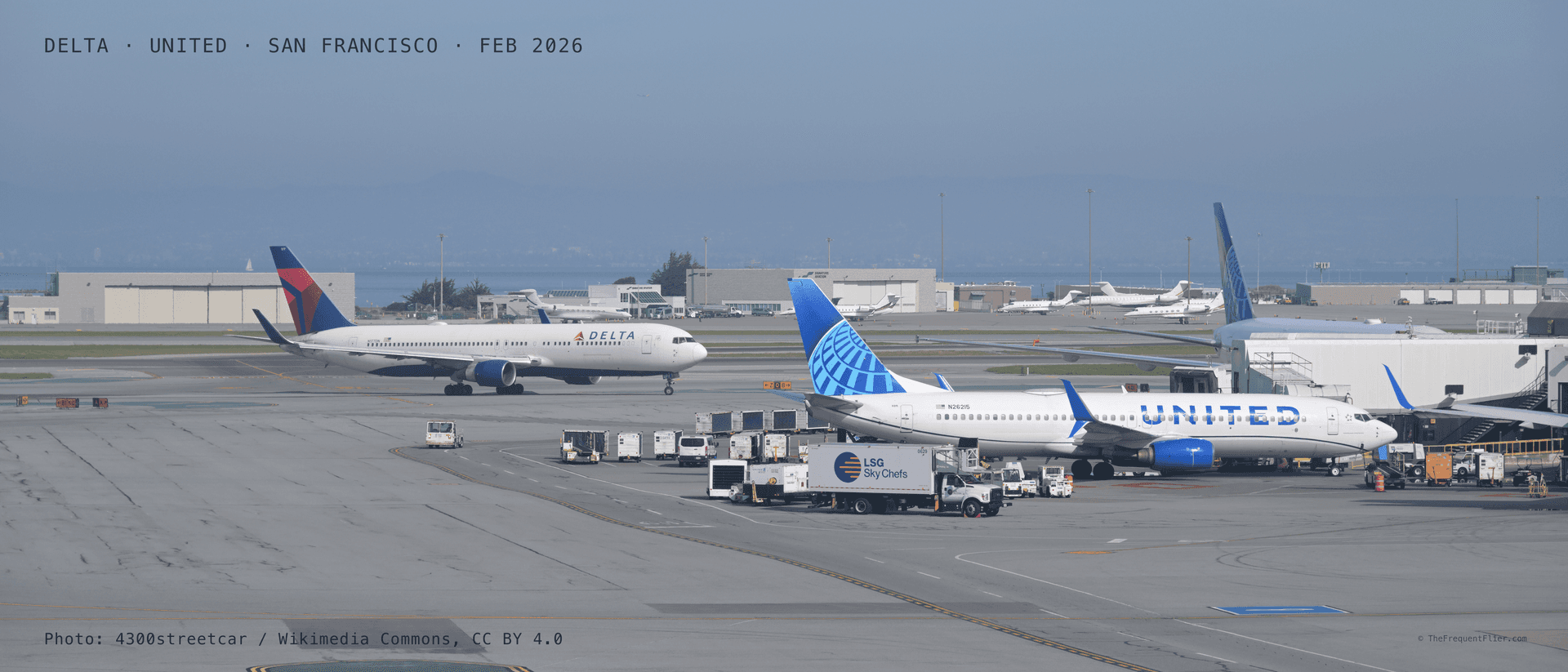
United CEO Scott Kirby approached Delta about merging the two airlines. Delta took the idea through due diligence, weighed it, and let the talks lapse. The Wall Street Journal reported the episode on July 26; neither carrier has said anything about it publicly.
The new part is the order. Kirby's approach to American came second; he confirmed that one on the record in April, after American turned him down. Delta came first.
Two networks, one shared airport
- United
- Delta
- Both carriers
The networks barely overlap
United runs eight hubs: Chicago, Denver, Houston, Newark, San Francisco, Dulles, Los Angeles, and Guam. Delta runs nine: Atlanta, Boston, Detroit, Minneapolis, JFK, LaGuardia, Salt Lake City, Seattle, and Los Angeles.
One airport appears on both lists.
New York is the contested ground. United built Newark, Delta built JFK and LaGuardia, and all three airports serve one catchment — the market any regulator would open the file on. Away from New York the two maps sit beside each other rather than on top of each other. Delta's midcontinent spine of Atlanta, Minneapolis, Detroit, and Salt Lake City touches none of Denver, Houston, Chicago, San Francisco, or Dulles.
For a combination this large, that is unusually clean. Big mergers normally spend years divesting overlapping city pairs and stripping out duplicate flying. There would have been far less of that here.
Delta passed anyway.
Delta already has the better business
Delta's June quarter, reported July 10, produced $1.4 billion in pre-tax profit while the company absorbed the highest quarterly fuel bill in its history. Revenue rose 14% on roughly 1% more flying.
American Express paid Delta $2.4 billion in that quarter alone, up 16% from a year earlier. Loyalty revenue rose 19%. Premium cabin revenue came in at $6.92 billion against $6.85 billion in the main cabin. Delta's commercial chief told analysts that main cabin capacity ran 2 to 3% below last year in the quarter, while premium capacity grew.
Across 2025 the Amex partnership was worth roughly $8 billion, about a tenth of everything Delta earned. Delta cardholders now account for 30% of American Express's US consumer spending.
Very little of that improves by adding United to it. Delta's most valuable asset is a bank relationship. What Amex pays for is the quality of Delta's customers, and a bigger route map does not make them better.
Nobody needs to merge
United is already enormous. It flew 182.9 million passengers in the twelve months through April 2026, on a fleet of 1,058 airframes.
Delta flew 201.1 million on 992.
Delta also filled more of its seats over that window, 83.6% against United's 82.8%, and landed on time more often, 80.9% against 78.9%. Whatever gap Kirby was trying to close, scale was not it.
Share of all US passengers flown
Twelve months through April 2026
383.9 million passengers
Together the two carriers flew 39.5% of all US passengers in that period, according to The Frequent Flier's traffic database, built on the Transportation Department's T-100 filings. American flew another 23.1%. Three airlines, 62.6% of the country. Those pages update monthly as new filings land.
At that concentration a merger buys very little the structure does not already hand over. The large US carriers have no need to coordinate on price. They add capacity carefully, watch each other do the same, and earn accordingly. Pepsi and Coke never had to call each other either.
Kirby went looking twice in roughly a year, at the two carriers whose businesses look least like United's. Both said no. Both are doing fine.
He was asked about further deals at the IATA annual meeting in Rio de Janeiro on June 7, seven weeks before the Journal's story ran.
“There could be another deal,” he said. “But, you just asked me what I think, and I think there's nothing.”
Explore the data
Agree or disagree?
Tell me what I missed, what you'd add, or where the argument breaks.