Status by the Dollar: American, Delta, and United Built the Same Program at Three Different Prices
All three US majors qualify elite status on a currency denominated in dollars, and at two of them a credit card can do the whole job with no flying at all. What they charge for the top tier differs by more than double.
If you’re chasing top-tier status at American, Delta, or United this year, the shortest path in front of you probably doesn’t involve an airplane.
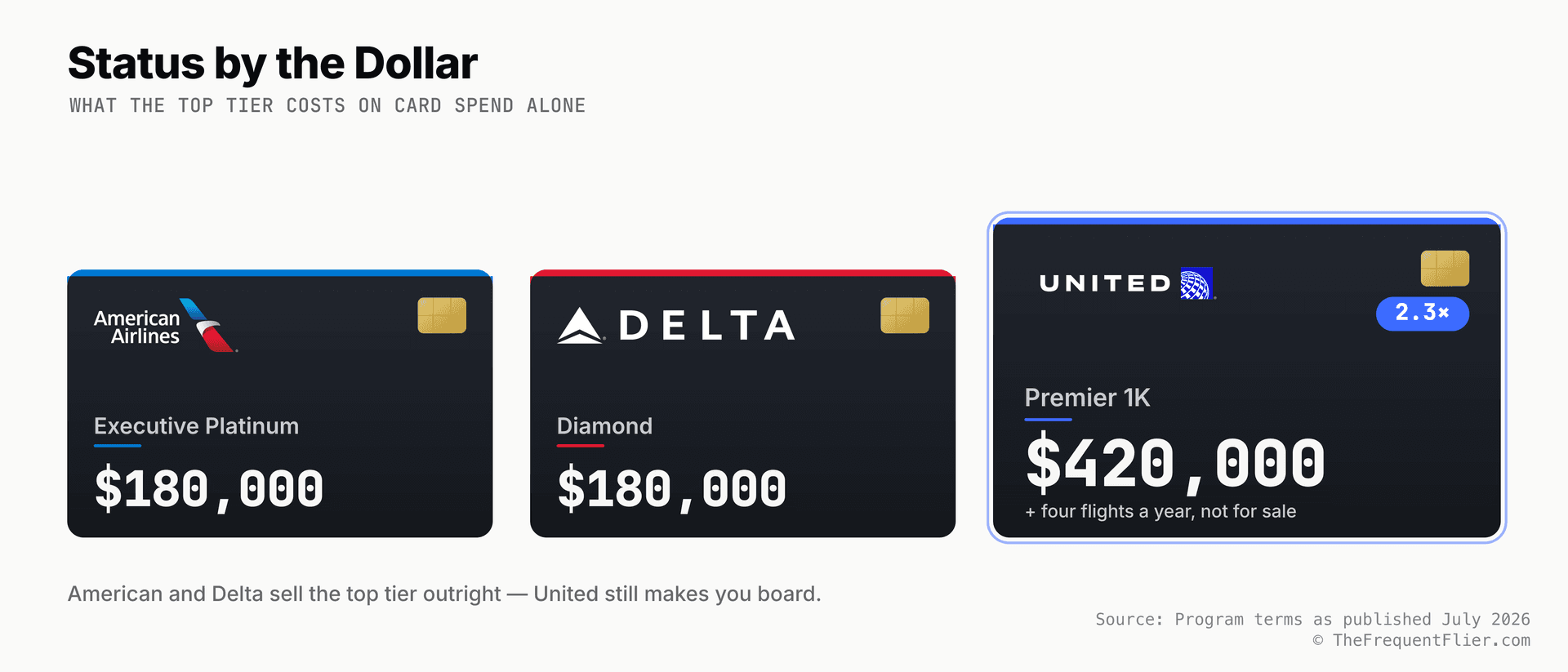
At American, Executive Platinum costs 200,000 Loyalty Points. A co-branded Citi card earns one Loyalty Point per dollar spent. The airline publishes no aggregate cap on how many of those points can come from the ground, and no minimum number of flights. Two hundred thousand dollars of spending gets you there. Carry the $595 Citi AAdvantage Executive card, which drops 10,000 bonus Loyalty Points at the 50,000 mark and another 10,000 at 90,000, and the figure falls to about $180,000.
Delta prices Diamond at $28,000 in Medallion Qualification Dollars. A Delta Reserve card earns one MQD per $10 of spend, and each eligible card type deposits a $2,500 head start, up to four types for $10,000. Collect all four head starts and put the remaining $18,000 of MQDs on a Reserve card, and you need $180,000 of spend. Run a single Reserve card alone and you need about $255,000.
United sets 1K at 28,000 Premier Qualifying Points, or 22,000 alongside 60 flights. The $695 United Club Infinite card earns one PQP per $15, capped at 28,000 a year — a ceiling set at precisely the number a 1K needs. Maxing it takes $420,000 of purchases. Then United asks you to board four of its flights regardless, and that part is not for sale.
Three programs, three currencies, one design. Nobody had to call anybody.
What the top tier costs on card spend alone
Lowest-cost route to each program's highest published tier
The currencies all became dollars
American went first. Loyalty Points arrived in 2022 and collapsed elite qualifying miles, segments and dollars into a single number that counts the same whether it comes from a transatlantic business fare or a grocery run.
Delta followed in September 2023, retiring Medallion Qualification Miles and Segments outright and proposing a Diamond tier at $35,000. The backlash was loud enough that Delta cut the numbers five weeks later, to the $28,000 that still stands today. The dollar-denominated currency survived the rollback intact, and with it the end of any path that pays for distance flown on its own.
United kept a flight-count option alongside the points. The spine of MileagePlus is PQP, and PQP tracks the fare rather than the mileage.
I earned Executive Platinum the old way, on mileage runs. A mileage run worked because the program paid well for something the airline struggled to sell — a seat on a Tuesday redeye to nowhere in particular. That arbitrage is closed at all three carriers now, and it closed for the same reason at each one.
How each program counts
| Carrier | Currency | Top tier | Card earning | Flying required |
|---|---|---|---|---|
 | CurrencyLoyalty Points | Top tierExecutive Platinum — 200,000 | Card earning1 point per $1, no published cap | Flying requiredNone |
 | CurrencyMedallion Qualification Dollars | Top tierDiamond — $28,000 | Card earning$1 MQD per $10 on Reserve, no published cap on spend earning | Flying requiredNone |
 | CurrencyPremier Qualifying Points | Top tier1K — 28,000, or 22,000 with 60 flights | Card earning1 PQP per $15 on Club Infinite, capped at 28,000 a year | Flying required4 United or United Express flights |



The second customer
Delta collected $8.2 billion from American Express in 2025, up 11%. On this month’s earnings call Ed Bastian guided to $9 billion for 2026. Reuters put the 2025 figure at about 14% of Delta’s adjusted operating revenue and roughly 1.4 times its adjusted operating income.
American’s co-branded card and other partner agreements paid $6.2 billion in 2025. Measured the same way, that is about four times American’s adjusted operating income.
United doesn’t disclose a comparable number. Its 10-K reports $3.2 billion of marketing and brand revenue recognized across all partner agreements, which is a narrower slice than the figures Delta and American describe and is not Chase-specific. Andrew Nocella told analysts in April that the Chase deal’s expiration “is not tomorrow, but it’s not that far off.”
Set those payments next to what the airlines fly. Over the twelve months through April 2026, Delta boarded 201.1 million passengers across 1.79 million departures. American boarded 224.5 million across 2.22 million. Delta’s Amex remuneration works out to roughly $41 per passenger boarded, American’s card and partner cash to roughly $28 — rough because the payments are calendar-2025 and the traffic runs a quarter later.
A company whose card partner pays it four times what its flying operation earns will design its loyalty program around the card partner. All three did.
United still makes you board
United is the outlier, and the shape of the exception is instructive.
Every Chase MileagePlus card carries a hard annual ceiling on PQP from spend: 1,000 on the Explorer, 4,000 on the Business, 18,000 on the Quest, 28,000 on the two Club cards. American and Delta publish no equivalent ceiling on points earned from card spend. United also holds a floor the other two abandoned — four United or United Express flights a year, which no amount of spending waives.
Then look at what United changed instead. In February the airline announced that from April 2, redeemable miles would be earned on two tracks. Cardholders went up one mile per dollar at every tier. Everyone else went down two. A general member without a United card fell from five miles per dollar to three, and to zero on basic economy. United left the price of status alone and marked down everything about not carrying the card.
Where the card is easiest to sell
The Frequent Flier’s traffic database, built on the Transportation Department’s T-100 filings, shows how differently these three networks are shaped. American runs Charlotte at 89% of the airport’s activity and Dallas/Fort Worth at 82%. Delta holds Atlanta at 80%. United’s three largest hubs by departures are its most contested, Denver among them. The pages update monthly as new filings land.
American
- Share of airport
- 89%
American
- Share of airport
- 82%
American
- Share of airport
- 67%
Delta
- Share of airport
- 80%
Delta
- Share of airport
- 72%
Delta
- Share of airport
- 71%
United
- Share of airport
- 74%
United
- Hub
- Newark (EWR)
- Share of airport
- 67%
United
- Hub
- Denver (DEN)
- Share of airport
- 50%
United
- Share of airport
- 50%
United
- Share of airport
- 47%
A flyer based in Charlotte has one realistic airline. A flyer in Denver has two, and a third down the concourse. Status is worth more where the alternative is worse, and a captive flyer is an easier card sale than a contested one. The two carriers with the deepest fortresses are the two that will sell you the top tier outright; the one whose biggest hubs are split is the one still asking you to show up at the gate. The shape fits. Whether it’s the cause, United hasn’t said.
Before you chase any of it
Run the arithmetic first. At American and Delta the question is what Executive Platinum or Diamond is worth to you against $180,000 of spending routed through one card, and what that same spending could have earned somewhere else. At United the card can carry the points and still leave you four boarding passes short, so the calculation has to include flights you were taking anyway.
Whichever program you pick, qualification now runs off your statement rather than your itinerary. If your spending is going somewhere else, your status is going there too.
Explore the data
Agree or disagree?
Tell me what I missed, what you'd add, or where the argument breaks.