Southwest's Record Quarter Is the First Real Read on Its Reinvention
Bag fees, basic fares, and assigned seating all hit the books together for the first time, and revenue set a record at $8.4 billion. Southwest still cut its full-year outlook. The two facts fit together: the rebuilt revenue engine works, and fuel decides what it earns.
Southwest flew its last open-boarding flight on January 27, ending the gate scrum after 54 years. By spring, every piece of the rebuild was in the market at once: assigned seats, extra-legroom rows, checked-bag fees, a basic fare. The quarter Southwest reported this week — April through June — is the first with all of it in the numbers for a full three months. That makes it the first honest reading on whether the reinvention earns money.
The reading came back loud. Revenue hit $8.4 billion, up 16.4% and the highest quarterly total in the company's history. Adjusted earnings of $0.94 a share nearly doubled the $0.51 analysts expected. And Southwest did it while absorbing nearly $900 million more in fuel costs than a year ago.
The gap the redesign exists to close
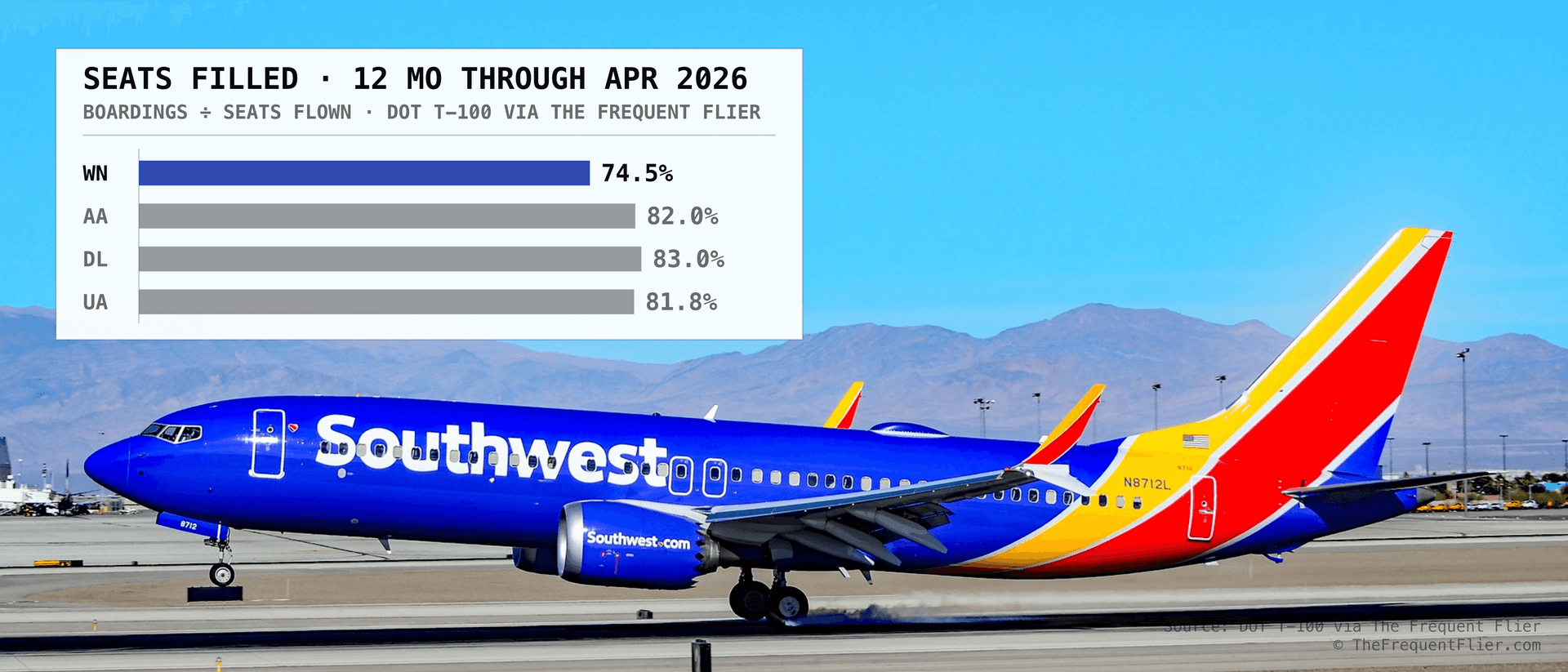
The reason this quarter mattered more than a normal earnings beat is structural. Southwest boards more passengers than any airline in America — 169.8 million over the twelve months through April, narrowly ahead of American and Delta. It also flies emptier planes than any of its big rivals: 74.5% of its seats had a passenger in them over that window, against 82–83% at American, Delta, and United. Those numbers come from The Frequent Flier's own traffic database, built on the Transportation Department's T-100 filings — every US airline reports its monthly passengers, seats, and departures, so the yardstick is identical for all four carriers. The gap is the whole logic of the redesign: plenty of passengers, not enough revenue per seat. Everything Southwest launched this year is a way of collecting more from airplanes it already flies.
The June quarter says the collecting works. Southwest flew essentially the same airline as last summer — capacity up 0.2% — and produced 16% more revenue from it. The average ticket reached $225.61, up 21% from a year ago. Unit costs outside fuel rose just 3.4%. And the gains aren't all fare inflation riding an industry-wide wave: corporate-travel revenue set an all-time record, up 30%, and Chase co-brand card acquisitions grew 28%.
There's a wonky footnote that makes the quarter look better, not worse. Southwest reversed $285 million of "breakage" — revenue it had already booked on the assumption that old flight credits would expire unused. Customers are redeeming those credits at a rate three points higher than the company modeled, so the revenue came back off the books. Strip out that accounting charge and adjusted revenue was $8.7 billion, up 20%. An airline whose problem is that customers use their credits too much has a problem most airlines would trade for.
The asterisk in the outlook
Then the asterisk. Southwest cut its full-year outlook to $3.25–$4.25 in adjusted earnings per share, from "at least $4.00," and trimmed planned capacity growth to roughly 1.5%. The third-quarter guide of $0.50 to $0.75 landed under the $0.82 consensus. None of that is a demand problem — Southwest expects revenue per seat mile to grow another 17.5% to 19.5% next quarter. It's fuel. Jet fuel averaged $3.92 a gallon in the quarter, up from $2.32 a year ago, part of the fuel shock that has been repricing the whole industry since spring. The revenue engine is doing what it was rebuilt to do. The fuel bill decides how much of that lands as profit.
What to watch next
The line worth watching from here is the seat map. The federal data runs through April, so the assigned-seating era is only beginning to show in the public numbers — Southwest's full network updates monthly in our database as new filings land. January (the month assigned boarding began, and a seasonally soft one in any year) was Southwest's emptiest of the past twelve, with 67% of seats filled. If the redesign works the way management is betting, that number grinds upward as travelers pay for seats they used to sprint for. If it doesn't, Southwest keeps trading empty middles for higher fares. Either way, the monthly filings will show it before the next earnings deck does.
One more note from the map: Denver is now Southwest's busiest base, at about 90,000 departures a year — and Southwest is still the number-two carrier there, behind United. The reinvention didn't redraw the network. It changed what a seat on it costs.
A year ago the open question was whether Southwest could rewrite its product mid-flight and still get paid for it. The rollout drew plenty of grumbling — new fees always do — but the revenue showed up on schedule, and the first full-quarter reading came back strong. What's left is a fuel story, and no airline gets to write that one for itself.
Explore the data
Agree or disagree?
Tell me what I missed, what you'd add, or where the argument breaks.